

Wired vs. Wireless TENS Units: Pros, Cons, and When to Choose Each
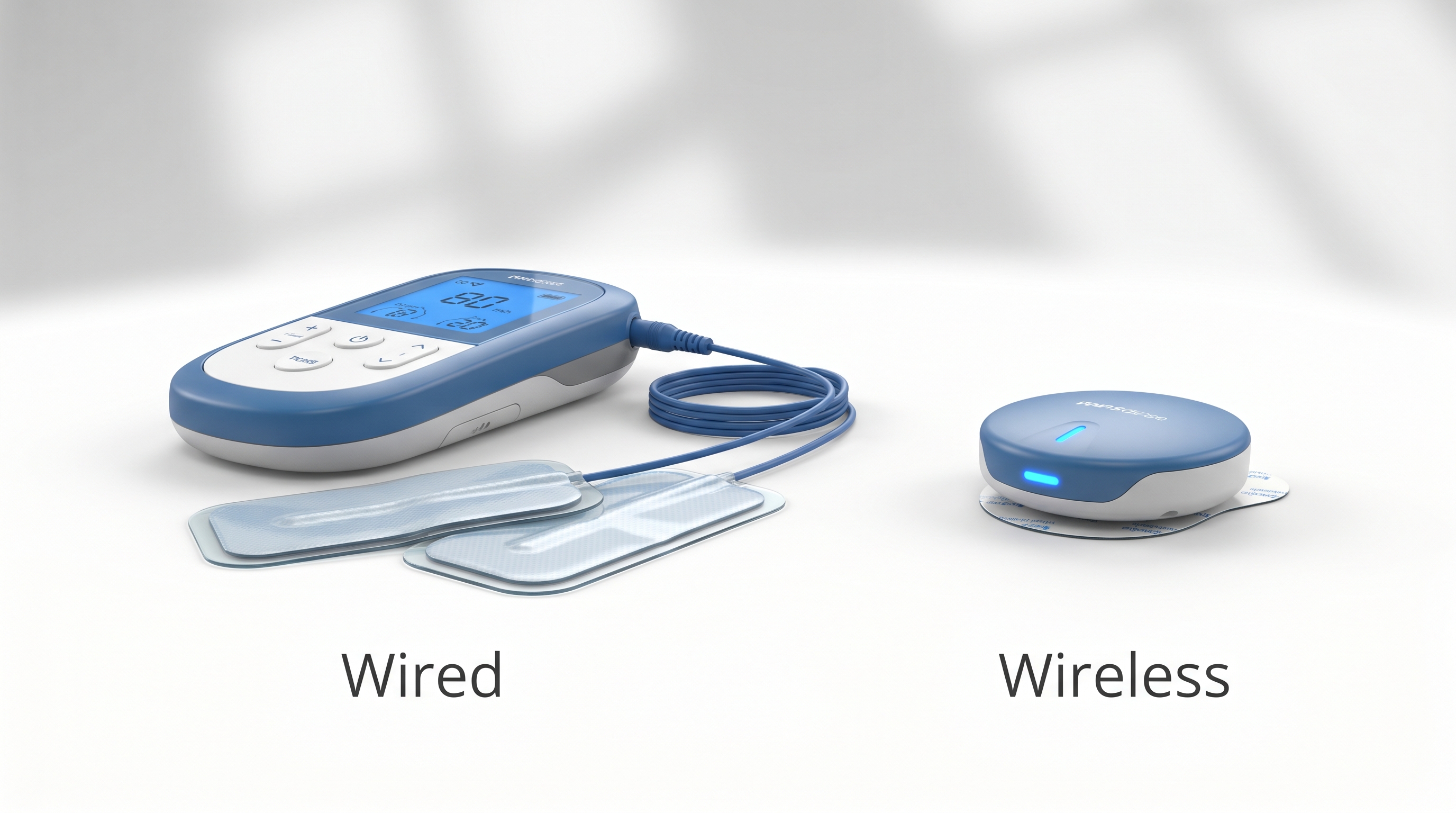
ALT: Wired and wireless TENS units compared for chronic pain management and muscle stimulation therapy at home
Understanding TENS Units: Does the Cable Really Matter?
Key Conclusion: Choosing between a wired and wireless TENS unit significantly impacts your pain relief experience. Both leverage the same core EMS technology and electrical nerve stimulation principles, but each format serves different lifestyles and needs. For individuals focused on chronic pain management, understanding the trade-offs in portability, precision, and cost is essential. Whether you're targeting back pain, recovering from surgery, or exploring muscle stimulation for athletic recovery, the right form factor can make or break your therapy routine.
TENS therapy — Transcutaneous Electrical Nerve Stimulation — has become one of the most popular drug-free tools for managing both acute and persistent pain at home. As the market has expanded, so has the variety of devices available. The decision between a wired and wireless TENS unit isn't purely aesthetic; it has real implications for usability, effectiveness, and long-term satisfaction.
This guide breaks down every meaningful difference between wired and wireless formats, provides a clear framework for choosing the right one, and helps you understand how each fits into a broader pain management or recovery routine.
Who Should Read This Guide?
✅ Applicable Scenarios:
- Adults managing chronic back, neck, shoulder, or joint pain who want a reliable at-home therapy option
- Athletes and fitness enthusiasts seeking muscle stimulation and faster post-workout recovery
- Postpartum women or individuals exploring pelvic floor therapy with electrical stimulation devices
- Health-conscious consumers evaluating drug-free alternatives to over-the-counter or prescription pain medication
❌ Not Applicable / Cautions:
- Individuals with implanted electronic devices such as pacemakers (TENS use requires physician approval)
- People with open wounds, active infections, or skin conditions at the intended electrode placement site
- Those seeking a TENS unit without any prior consultation when managing serious or undiagnosed medical conditions
The Growing World of Electrotherapy: Why Format Matters
Electrotherapy has moved steadily from clinical settings into everyday homes over the past two decades. What was once reserved for physical therapy offices is now available in compact, affordable devices trusted by millions of users worldwide. The core science behind TENS therapy — using low-voltage electrical pulses to interrupt pain signals along nerve pathways — remains consistent regardless of whether the device uses wires or transmits wirelessly.
To understand how these signals work at a neurological level, the article How TENS Units Stimulate Nerve Fibers to Block Pain Signals to the Brain provides an excellent clinical foundation. The mechanisms are identical across device formats — what differs is how you interact with the device during treatment.
Consumer demand has driven manufacturers to innovate in two distinct directions: wired units that prioritize reliability and power, and wireless units that prioritize freedom of movement and discreet use. Understanding what each format does well — and where each falls short — is the first step toward making an informed purchase. For those still exploring whether TENS therapy is the right approach for their condition, TENS vs. Prescription Pain Medication: A Non-Invasive Alternative Explained offers a helpful comparison between electrotherapy and pharmaceutical options.
The best electrotherapy devices for chronic back pain relief at home are those that match your lifestyle as much as your pain profile. A device you don't use consistently because it's inconvenient won't deliver the results you're looking for — no matter how advanced its settings may be.
Choosing the Right TENS Unit: A Three-Step Decision Framework
Making the Right Choice for Your Lifestyle and Pain Goals
Step 1: Identify Your Primary Use Context
Before comparing specific features, clarify when and where you plan to use your TENS unit most often. Are you typically seated at home during sessions, or do you want to continue moving — working, exercising, or completing daily tasks — while the device operates? Users who plan to remain stationary during therapy (for example, lying down during a 20–30 minute session for lower back pain) will find the limitations of wired devices largely irrelevant. Active users who want to use their device during commutes, workouts, or office hours will immediately notice the freedom a wireless format provides.
Step 2: Evaluate Your Technical Comfort and Priorities
Consider your comfort level with technology and what matters most to you: simplicity and reliability, or flexibility and advanced control. Wired TENS units typically feature straightforward physical controls — dials, buttons, and clear labeling — that appeal to users who prefer tactile, intuitive operation. Wireless units often pair with smartphone apps, offering more granular control over programs and intensity, but require some comfort with mobile interfaces. Battery life, recharging habits, and the potential need for replacement components are also worth factoring in at this stage.
Step 3: Match the Device Format to Your Specific Condition
Different pain conditions and therapy goals lend themselves to different formats. Localized, stationary pain — such as chronic lower back pain addressed during a dedicated rest period — suits wired units well. Widespread or multi-site pain (shoulders and knees simultaneously, for instance) may benefit from multi-channel wired devices that can deliver therapy to several areas at once. Conversely, conditions that flare unexpectedly throughout the day, such as joint discomfort during activity, make a portable wireless unit significantly more practical. For athletes integrating electrical muscle stimulation into training, the format choice often hinges on whether the device is used during or after physical activity.
Wired vs. Wireless TENS Units: A Feature-by-Feature Comparison
Both formats deliver the same core electrical therapy, but the experience differs in several important ways. The table below outlines the key dimensions to consider when evaluating your options.
| Comparison Dimension | Wired TENS Units | Wireless TENS Units | Notes |
|---|---|---|---|
| Portability | Limited — requires lead wires that restrict movement | High — pads adhere directly to skin, no tethering | Critical for active users |
| Signal Reliability | Consistent — direct electrical connection via wires | Generally reliable; minor interference possible in some environments | Wired offers more stable output |
| Ease of Setup | Moderate — attaching wires to pads requires care | Simple — fewer components to connect | Wireless wins for on-the-go use |
| Channel Capacity | Often multi-channel (2–4 channels common) | Typically single or dual-channel per unit | Wired devices often cover more areas simultaneously |
| Battery/Power | May run on replaceable batteries or rechargeable packs | Typically rechargeable via USB | Both vary by model |
| Durability of Connection | Lead wires may wear over time but are replaceable | No cables to degrade; pod/transmitter requires care | Wire replacement is a known maintenance need |
| Cost | Generally more affordable entry points | Often higher upfront cost for wireless pods | Long-term costs depend on accessories |
| Discretion During Use | Visible wires can be challenging to conceal | Can be worn under clothing discreetly | Wireless excels for workplace or social settings |
| Customization / Programs | Many preset and adjustable modes | App-controlled units offer high customization | Depends heavily on specific device |
| Ideal For | Home-based stationary therapy, clinical-style treatment | Active users, discreet daily pain management | Neither is universally superior |
Deep Dive: The Real-World Pros and Cons of Each Format
Wired TENS Units: The Case for Reliability
Wired TENS units have been the standard in both clinical and home settings for decades, and for good reason. The direct lead-wire connection between the control unit and electrode pads ensures a stable, uninterrupted electrical signal — a key consideration when you're relying on consistent pulse delivery for effective chronic pain management.
One of the most practical advantages of wired devices is their multi-channel capability. Many professional-grade wired units support two to four independent output channels, allowing you to treat multiple body areas in a single session. This is especially valuable for users managing pain in more than one location — for example, addressing both shoulder tension and lower back discomfort simultaneously. For a detailed guide on maximizing multi-channel therapy, 4-Channel TENS/EMS: How to Treat Multiple Body Areas Simultaneously is an excellent resource.
Wired units also tend to offer a broader range of intensity settings and therapy programs, making them well-suited for users who want clinical-grade versatility at home. The physical controls on most wired devices — clear buttons, easy-to-read displays, and adjustable dials — appeal to users who prefer straightforward, tactile interaction without the need for a smartphone.
The main limitation is obvious: the cables. Lead wires restrict your range of motion during treatment and can become tangled or damaged over time. For users who plan to rest or sit quietly during sessions, this is rarely a significant issue. For those who want to stay active, it can be genuinely frustrating.
Wireless TENS Units: The Case for Freedom
Wireless TENS units represent a newer generation of electrotherapy technology. Instead of a tabletop control unit connected to pads via cables, wireless systems embed the electronics within small adhesive pods that attach directly to the skin. The result is a device that can be worn under clothing, used during movement, and operated discreetly throughout the day.
For users managing pain during their daily routines — at a desk job, during light exercise, or while traveling — the wireless format is transformative. There are no wires to manage, no control box to set down, and no visible equipment to explain. Many wireless units pair with dedicated smartphone apps, offering customizable programs, timer controls, and real-time intensity adjustments at your fingertips.
The trade-off is primarily one of complexity and cost. Wireless pods are more expensive to replace than standard electrode pads and lead wires, and the devices themselves often carry a higher price point. Battery management becomes a more active consideration, as the pod itself must be recharged between sessions. Some users also find app-based interfaces less intuitive than physical device controls, particularly for older adults or those less comfortable with mobile technology.
That said, wireless TENS units have become increasingly reliable and user-friendly. For individuals whose lifestyle simply doesn't accommodate sitting still for 20–30 minutes at a time, they represent the only practical path to consistent therapy use.
When EMS Technology Changes the Equation
It's worth noting that many modern devices combine TENS and EMS technology within a single unit — whether wired or wireless. While TENS targets pain relief through nerve signal interruption, EMS directly stimulates muscle contractions for recovery, strengthening, and circulation support. Athletes in particular benefit significantly from EMS functionality, a topic explored in depth in EMS for Athletes: How Professional Sports Teams Use Electrical Muscle Stimulation.
If your goals include both pain relief and muscle conditioning, choosing a combo device — and understanding which mode to use when — is just as important as the wired-versus-wireless decision. The guide TENS + EMS Combo Machines Explained: When to Use Each Mode provides clear guidance on maximizing both modalities.
For postpartum women exploring electrical stimulation for pelvic floor rehabilitation, the format question takes on additional nuance. Kegel electrical stimulation devices are typically wired, using internal probes connected to a control unit, and are not designed for discreet wear during daily activities. Instead, they're used during focused, stationary therapy sessions — making the wired format entirely appropriate. Proper electrode placement guidance is equally important across all TENS/EMS applications, and the TENS Electrode Pad Buyer's Guide: Sizes, Materials, and Compatibility Explained is a valuable reference for understanding pad compatibility across device types.

ALT: Wireless TENS unit worn discreetly under clothing for on-the-go chronic pain management and muscle stimulation therapy
Advanced Considerations: Scenarios, Misconceptions, and Integration
Special Situations Worth Knowing
Multi-site chronic pain: Users managing pain across several body regions simultaneously will generally find wired multi-channel units more practical. A quality four-channel wired device can address the neck, both shoulders, and the lower back in a single session — a capability most wireless units cannot match without purchasing multiple pods.
Athletic recovery and muscle conditioning: Athletes who want to use EMS during active training or immediately after intense workouts may prefer a wireless format for its freedom of movement. However, high-intensity EMS protocols often benefit from the stable power delivery of a wired device. The best approach depends on the specific activity and intensity level involved.
Long-term daily use: For users who plan to rely on their TENS unit as a core part of their daily pain management routine, durability and total cost of ownership matter significantly. Wired devices offer the advantage of component replaceability — if lead wires wear out, they can be replaced affordably without retiring the entire unit. Wireless pods, being more integrated, may have higher replacement costs if the electronic components fail.
Common Misconceptions Clarified
A widespread misconception is that wireless TENS units are inherently more powerful or effective than wired ones. This is not accurate. Therapeutic effectiveness depends on pulse parameters, intensity settings, electrode placement, and consistency of use — not on whether the signal travels through a wire. Both formats can deliver clinically meaningful therapy when used correctly.
Another common misunderstanding is that wired units are "outdated." In clinical physical therapy settings, wired multi-channel devices remain the standard precisely because of their reliability, channel capacity, and power output range.
Finally, some users assume that wireless units are always smaller or more compact. This varies significantly by manufacturer and model. Some wired units are highly portable, while some wireless pods can be bulkier than expected.
Frequently Asked Questions FAQ
Q1: How do I know which TENS unit format is best for chronic back pain relief at home?
For chronic back pain managed at home, either format can be effective — but your lifestyle is the deciding factor. If you can comfortably dedicate 20–30 minutes to a stationary session, a wired multi-channel unit gives you more program options, stable signal delivery, and the ability to treat multiple lumbar and surrounding muscle areas simultaneously. If your back pain flares during daily activity and you need relief on the go, a wireless unit's freedom of movement may make it the more consistent choice. Consistency of use is the most important variable in long-term pain management outcomes.
Q2: Are wireless TENS units as effective as wired ones for muscle stimulation?
Yes — when used correctly, wireless TENS and EMS units can deliver equivalent therapeutic effects to wired devices for many applications. The core electrical parameters — pulse width, frequency, and intensity — determine therapeutic outcome, and both formats can deliver appropriate ranges. Wired units may have an edge in high-intensity EMS protocols or multi-channel muscle stimulation sessions, as their power delivery tends to be more stable. For general muscle recovery and moderate pain relief, wireless units perform comparably for most users.
Q3: How long does it typically take to see results from TENS therapy, regardless of the device format?
Most users report noticeable pain relief during or shortly after their first TENS session, though the duration of relief varies. For acute pain, improvement may be felt within one to three sessions. For chronic conditions, consistent use over several weeks typically yields the most meaningful and lasting results. The format — wired or wireless — does not significantly affect the timeline; what matters is using the device regularly, with appropriate settings for your condition, and maintaining correct electrode placement as guided by your healthcare provider.
Summary
Choosing between a wired and wireless TENS unit ultimately comes down to three core considerations: your daily lifestyle and mobility needs, your specific pain management or recovery goals, and your comfort level with the technology involved.
Wired TENS units offer clinical-grade reliability, multi-channel capability, a broader range of intensity programs, and typically lower replacement costs — making them an excellent choice for home-based, stationary therapy sessions targeting chronic or complex pain conditions.
Wireless TENS units deliver unmatched freedom of movement, discreet wearability, and the convenience of app-based control — making them the clear choice for active users, commuters, or anyone who cannot or does not want to pause their day for therapy.
For users whose goals span both pain relief and muscle conditioning, a combo TENS/EMS device — whether wired or wireless — may provide the most versatile long-term value. Understanding the science behind how these therapies work, as explored in The Science Behind Endorphin Release During TENS Therapy, reinforces why consistent use of either format delivers real, measurable benefits.
The best device is the one you will use consistently, position correctly, and integrate thoughtfully into your wellness routine. No cable — or lack thereof — changes that fundamental truth.
Call to Action
Ready to take control of your pain relief and muscle wellness from the comfort of home? iStim offers a full range of professional-grade TENS, EMS, and Kegel devices designed to deliver real, drug-free results — trusted by over 20,000 satisfied customers. Explore the complete lineup and find the right device for your needs at https://istim.com/.
References
- National Institutes of Health — National Library of Medicine. "Transcutaneous Electrical Nerve Stimulation (TENS) for Chronic Pain."
https://www.ncbi.nlm.nih.gov/books/NBK537188/ - American Physical Therapy Association (APTA). "Physical Therapy Guide to Pain Management."
https://www.choosept.com/guide/physical-therapy-guide-chronic-pain - Mayo Clinic. "Transcutaneous Electrical Nerve Stimulation (TENS)."
https://www.mayoclinic.org/tests-procedures/tens/about/pac-20384994 - U.S. Food and Drug Administration (FDA). "TENS Devices — General Information for Consumers."
https://www.fda.gov/medical-devices/consumer-products/nerve-stimulators - Cochrane Library. "Transcutaneous Electrical Nerve Stimulation (TENS) versus Placebo for Chronic Pain."
https://www.cochranelibrary.com/cdsr/doi/10.1002/14651858.CD006343.pub3/full
Note: Standards and clinical guidance may be updated. Please check the latest official documents or consult a qualified healthcare professional for current recommendations.
About iStim
iStim is a Los Angeles-based electrotherapy brand specializing in professional-grade TENS, EMS, and Kegel devices engineered for safe and effective home use. With ISO-certified Taiwanese manufacturing and a growing community of 20,000+ Amazon customers, iStim is a trusted name in drug-free pain relief and muscle stimulation.
Disclaimer: This article is provided for informational and educational purposes only and does not constitute medical advice. Always consult a qualified healthcare professional before beginning any new treatment or therapy. iStim is not responsible for any actions taken based on the content of this article.
© iStim. All rights reserved. | https://istim.com/
Leave a comment