

What Is Cervical Neck Traction and How Does It Relieve Neck Pain?

ALT: Person using cervical neck traction device for drug-free neck pain relief and spinal decompression at home
What Is Cervical Neck Traction and How Does It Relieve Neck Pain?
Key Conclusion: Cervical neck traction is a clinically recognized, non-invasive therapy that gently stretches the cervical spine to decompress compressed discs, relieve nerve pressure, and reduce muscle tension. Whether performed by a physical therapist or through at-home devices, cervical traction addresses the root mechanical causes of neck pain — making it a powerful drug-free alternative for conditions ranging from herniated discs to chronic stiffness and nerve-related radiating pain into the arms and shoulders.
Neck pain is one of the most prevalent musculoskeletal complaints in the modern world, affecting people who sit at desks for hours, athletes who push their bodies to the limit, and seniors managing age-related spinal changes. Cervical neck traction offers a time-tested, evidence-based approach to addressing the structural drivers of neck discomfort rather than simply masking symptoms. In this guide, we'll walk you through exactly what cervical traction is, how it works biomechanically, who can benefit most, and how to safely incorporate it into a broader pain management strategy — including complementary electrotherapy tools that can amplify your results.
Who Benefits From Cervical Neck Traction — and Who Should Avoid It
✅ Applicable Scenarios:
- Individuals with herniated or bulging cervical discs experiencing localized neck pain or radiating pain into the shoulders, arms, or hands
- People suffering from cervical spondylosis (age-related degeneration of cervical vertebrae and discs) causing stiffness and nerve compression
- Those with cervicogenic headaches or tension headaches originating from cervical muscle tightness and facet joint compression
- Office workers and remote professionals with chronic forward-head posture and upper trapezius tension
- Physical therapy patients seeking adjunct home therapy between clinical appointments to maintain decompression benefits
- Athletes recovering from soft tissue neck injuries where gentle distraction aids circulation and healing
❌ Not Applicable/Cautions:
- Individuals with cervical instability, fractures, or severe osteoporosis — traction forces could worsen structural compromise
- People with spinal cord compression (myelopathy), where any spinal manipulation or distraction must be medically supervised
- Those with rheumatoid arthritis affecting the cervical spine, as ligamentous laxity may increase injury risk
- Patients who have had recent cervical spine surgery without explicit clearance from their surgeon
- Pregnant women, particularly in later trimesters, should consult their healthcare provider before using any mechanical traction device
- Anyone experiencing acute inflammation, infection, or tumor in the cervical region should seek immediate medical evaluation rather than traction
Understanding the Anatomy Behind Cervical Neck Pain
To appreciate why cervical traction works, it helps to understand what's happening inside your neck when pain strikes. The cervical spine consists of seven vertebrae (C1–C7) separated by intervertebral discs — cushion-like structures filled with a gel-like nucleus. These discs absorb shock, allow flexible movement, and maintain healthy spacing between vertebrae so that nerve roots can exit the spinal canal without compression.
Cervical neck pain most commonly develops when this delicate architecture is disrupted. Herniated discs, in which the inner nucleus pushes through the outer disc wall, can press directly on adjacent nerve roots — producing sharp, burning, or electric pain that travels down the arm. Degenerative disc disease gradually reduces disc height, narrowing the foramina (openings through which nerves exit) and increasing the risk of nerve impingement. Muscle tension compounds these structural issues: tight posterior neck muscles pull the vertebrae closer together, increasing intradiscal pressure and perpetuating the pain cycle.
According to the Global Burden of Disease Study, neck pain is among the leading causes of years lived with disability worldwide, with prevalence particularly high among working-age adults who spend extended periods at screens. This epidemic of desk-related cervical strain has fueled growing interest in non-pharmacological interventions — and cervical traction sits at the intersection of clinical evidence and practical accessibility.
For those already exploring drug-free pain management approaches, understanding the broader electrotherapy landscape is equally valuable. What Is TENS Therapy and How Does It Relieve Pain Without Drugs? provides an excellent foundation for how bioelectrical approaches can complement mechanical therapies like traction to create a truly comprehensive, non-pharmaceutical pain relief strategy.
The growing body of research on conservative cervical pain management consistently positions traction — either mechanical or manual — as an effective first-line option before considering more invasive interventions like epidural injections or surgical decompression. Understanding this context empowers patients to make informed, proactive choices about their care.
How Cervical Neck Traction Works: From Mechanism to Practice
Getting Started With Cervical Traction: A Three-Step Approach
Step 1: Choose the Right Type of Cervical Traction Device
Cervical traction devices broadly fall into three categories: over-the-door pulley systems (which use gravity and a water-filled bag to create distraction force), inflatable neck collars (which use air pressure to gently elongate the cervical spine), and supine mechanical traction units (often found in clinical settings but increasingly available for home use). Each has distinct advantages. Over-the-door systems tend to offer more consistent and adjustable traction force, while inflatable collars offer portability and ease of use for mild cases. Discuss with your physical therapist or physician which type is appropriate for your specific diagnosis before purchasing.
Step 2: Establish Proper Positioning and Starting Intensity
Correct positioning is critical to safe, effective cervical traction. For most devices, the neck should be positioned in approximately 15–25 degrees of forward flexion — this angle optimally opens the posterior intervertebral spaces and foramina where nerve roots exit. Start with the minimum recommended traction force for your device and session duration; many physical therapists recommend beginning with shorter sessions and gradually increasing as tolerated. Never begin with aggressive traction forces, especially if you are new to the therapy or managing acute disc herniation.
Step 3: Combine Traction With a Complementary Recovery Protocol
Cervical traction is most effective as part of a broader therapeutic plan. After a traction session, incorporate gentle cervical range-of-motion exercises to reinforce the decompression benefits and prevent muscles from reflexively tightening. Electrotherapy modalities — such as TENS (Transcutaneous Electrical Nerve Stimulation) — can be used before or after traction to further reduce muscle guarding, improve circulation, and manage residual pain. This synergistic approach mirrors what physical therapists do in clinical settings, combining passive decompression with active neuromuscular re-education for lasting results.
Comparing Cervical Neck Traction Methods: Which Approach Is Right for You?
Not every cervical traction approach suits every individual. The method you choose depends on your diagnosis, lifestyle, budget, and access to professional guidance. Below is a comparative overview of the three primary modalities to help you and your healthcare provider make an informed decision.
| Comparison Dimension | Manual Traction (Therapist-Applied) | Over-the-Door Mechanical Traction | Inflatable Cervical Collar |
|---|---|---|---|
| Force Control | Highly precise, real-time adjustment by clinician | Adjustable via weight/resistance; requires self-monitoring | Limited precision; depends on inflation level |
| Accessibility | Requires clinic appointment | At-home use after initial instruction | Highly portable; usable anywhere |
| Cost | Higher ongoing cost (per-session fees) | Moderate upfront investment; low ongoing cost | Generally lowest cost option |
| Best For | Acute/severe cases; initial diagnosis phase | Moderate to chronic cases; maintenance therapy | Mild tension, travel, posture support |
| Clinical Evidence | Strong; gold standard for acute disc herniation | Good; widely studied for home cervical traction | Limited; primarily symptomatic relief |
| Safety Monitoring | Continuous therapist oversight | Self-monitored; requires user education | Self-monitored; lower risk of overuse injury |
| Integration With Electrotherapy | Often combined with TENS/EMS in clinic | Can be paired with home TENS units | Compatible with TENS pre/post application |
The most successful outcomes typically involve beginning under professional supervision — allowing your therapist to assess your response, optimize positioning, and confirm that traction is appropriate for your specific cervical pathology — before transitioning to a home maintenance protocol.
The Science of Decompression: What Happens to Your Cervical Spine During Traction
When a distraction force is applied along the cervical spine's longitudinal axis, several biomechanical events unfold simultaneously. Understanding these mechanisms helps explain why patients often report immediate relief during traction, even before cumulative therapeutic effects develop.
Intradiscal Pressure Reduction
The most direct effect of cervical traction is a reduction in intradiscal pressure within the cervical discs. By gently separating the vertebral bodies, traction creates a negative pressure gradient within the disc — a phenomenon sometimes called the "vacuum effect." This pressure drop can draw herniated nuclear material back toward the center of the disc, reducing the mechanical compression on adjacent nerve roots. Research published in clinical physical therapy literature has documented measurable increases in disc height and foraminal diameter during sustained cervical traction, correlating with the subjective pain relief patients experience.
Facet Joint Distraction and Pain Gate Activation
Beyond the discs themselves, cervical traction stretches the posterior joint capsules and facet joints — small paired joints at the back of each vertebral level that guide movement and bear compressive load. Distraction of these joints stimulates mechanoreceptors in the joint capsule and surrounding ligaments, activating the pain gate mechanism (the same neurological principle underlying TENS therapy's analgesic effect). This flood of non-nociceptive sensory input effectively competes with and suppresses pain signals traveling to the brain, providing immediate symptomatic relief during and after treatment sessions.
Muscle Relaxation and Trigger Point Release
Chronic neck pain almost universally involves a component of myofascial dysfunction — areas of sustained muscle contraction in the cervical extensors, suboccipitals, and upper trapezius that create localized tenderness and refer pain to predictable patterns. The sustained stretch applied through cervical traction encourages these muscles to release, reducing the reflexive protective guarding that perpetuates the pain-tension cycle. Patients often describe a notable softening of neck and shoulder tension following traction sessions, even when their primary complaint was disc-related.
Circulation and Nutrient Exchange
Intervertebral discs are avascular structures — they rely on diffusion from adjacent vertebral endplates to receive oxygen and nutrients, and to expel metabolic waste products. Sustained compressive loading from poor posture, muscle tension, or degeneration impairs this diffusion process. Cyclic or intermittent traction — where the distraction force is applied and released in rhythmic intervals — has been shown to improve this nutrient exchange mechanism, supporting disc health over time and potentially slowing degenerative progression.
Combining Traction With TENS and EMS for Enhanced Outcomes
Many physical therapists prescribe cervical traction alongside electrical stimulation modalities because their mechanisms are complementary rather than redundant. TENS units target neural pain pathways and promote endorphin release, while EMS devices activate and strengthen the deep cervical stabilizer muscles that support proper spinal alignment. Understanding What Is EMS (Electrical Muscle Stimulation) and How Is It Different from TENS? can help you build a smarter, more complete neck pain management protocol that addresses both the symptomatic and functional dimensions of cervical dysfunction.
For individuals managing broader musculoskeletal pain alongside their neck issues, the TENS Unit Buyer's Guide: What to Look for in a Home Electrotherapy Device is an invaluable resource for selecting the right device to complement your cervical traction routine at home.
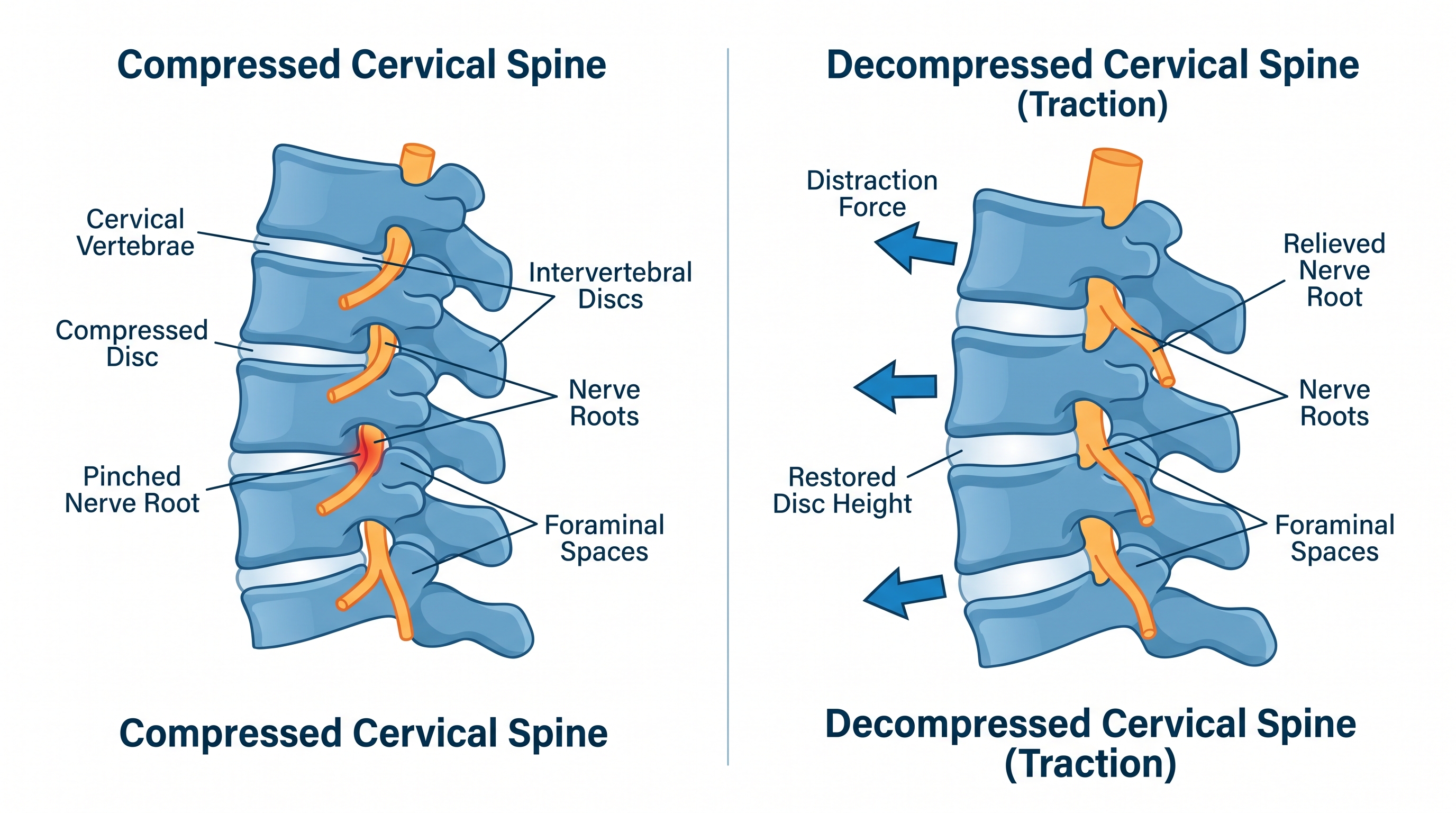
ALT: Diagram showing cervical neck traction mechanism with vertebral decompression, disc height restoration, and nerve root relief for neck pain treatment
Advanced Considerations: Optimizing Cervical Traction Outcomes
Special Situations That Require Modified Approaches
Managing Radiculopathy (Radiating Arm Pain)
If your cervical pain includes significant radiating symptoms into the arms — tingling, numbness, or weakness — cervical traction may be particularly beneficial, but requires careful monitoring. Radiculopathy indicates active nerve root compromise, and while traction can alleviate mechanical pressure, the initial sessions may temporarily provoke symptoms as nerve tissue mobilizes. Always perform traction under guidance in this context and report any changes in symptom distribution or intensity to your healthcare provider promptly.
Post-Physical Therapy Maintenance
Many patients complete a formal physical therapy program for cervical pain and then face the challenge of maintaining their gains at home. At-home cervical traction devices, used correctly and consistently, can serve as an effective maintenance tool to prevent symptom recurrence between flare-ups. Pairing this with a home TENS unit for on-demand pain management creates a sustainable, drug-free self-care system.
Seniors With Degenerative Cervical Changes
Older adults with cervical spondylosis require modified traction parameters — generally lower forces and shorter sessions — due to the reduced hydration and structural resilience of aging discs and ligaments. The presence of osteoporosis is a contraindication to mechanical traction; bone mineral density assessment should be confirmed before beginning any traction protocol in seniors.
Common Misconceptions About Cervical Traction
Misconception 1: "More force equals faster relief."
This is one of the most dangerous misconceptions. Excessive traction force can strain ligaments, aggravate nerve roots, and cause muscle spasm — the opposite of the intended effect. Effective cervical traction uses precisely calibrated, moderate distraction forces applied consistently over time.
Misconception 2: "Cervical traction cures disc herniations permanently."
Traction can reduce disc herniation symptoms and even facilitate partial disc retraction, but it does not permanently restructure disc anatomy. It is a management tool — highly effective when combined with exercise, posture correction, and lifestyle modification — not a cure.
Misconception 3: "Inflatable collars are just as effective as mechanical traction."
While inflatable collars can provide symptomatic relief and mild decompression, clinical evidence most strongly supports mechanical traction devices with measurable, consistent distraction force for addressing structural cervical pathology.
Frequently Asked Questions About Cervical Neck Traction
Q1: How does cervical neck traction differ from chiropractic neck manipulation?
Cervical traction and chiropractic manipulation both target the cervical spine, but their mechanisms differ significantly. Traction applies a sustained or rhythmic longitudinal distraction force to decompress discs and stretch soft tissues gradually. Chiropractic manipulation involves high-velocity, low-amplitude thrusts to restore joint mobility and reduce fixation. Traction is generally considered lower-risk for individuals with disc herniations, as it avoids the rotational and lateral forces inherent in manipulation. Always consult both your physician and chosen practitioner to determine which approach — or combination — suits your specific diagnosis.
Q2: Is cervical neck traction safe to use every day at home?
Daily use of cervical traction can be appropriate for some individuals, but session frequency and duration should be guided by your physical therapist or physician based on your diagnosis and response to treatment. Many clinical protocols recommend starting with several sessions per week and adjusting based on symptom response. Overuse — particularly at excessive force — can lead to muscle soreness, ligamentous strain, or rebound stiffness. As a general principle, if symptoms worsen with any session, reduce frequency and force and consult your provider before continuing.
Q3: How long does it take to see results from cervical traction therapy?
Response timelines vary based on the underlying condition, severity, and consistency of treatment. Some individuals report noticeable symptom relief after just a few sessions; others with more significant degenerative changes may require several weeks of consistent therapy before experiencing meaningful improvement. Research on cervical traction for radiculopathy suggests that a course of four to six weeks of regular traction — combined with therapeutic exercise — is typically needed to assess the therapy's full benefit. Patience and consistency, paired with professional oversight, are key predictors of success.
Summary
Cervical neck traction is far more than a simple stretching technique — it is a biomechanically sophisticated, clinically supported therapy that addresses the root mechanical causes of neck pain at the level of the disc, nerve root, facet joint, and musculature. Here are the three core takeaways from this guide:
- Traction works by decompressing the cervical spine — reducing intradiscal pressure, opening foraminal spaces, and releasing muscle tension through a coordinated set of mechanical and neurological mechanisms that directly counteract the forces driving most common cervical pain conditions.
- Choosing the right type of traction and using it correctly is essential — manual, mechanical, and inflatable options each serve different needs, and safe, effective outcomes depend on proper positioning, appropriate force levels, and professional guidance, especially for individuals with active disc herniations or nerve root involvement.
- Cervical traction is most powerful as part of a comprehensive, drug-free pain management strategy — combining traction with electrotherapy modalities like TENS and EMS, therapeutic exercise, and postural re-education creates synergistic effects that address both the symptoms and the functional drivers of chronic cervical pain.
Your next step: if you haven't already discussed cervical traction with your physical therapist or physician, bring this guide to your next appointment and ask whether it's appropriate for your specific condition. If you're already cleared for home traction, explore how a professional-grade TENS unit can amplify your results between sessions.
Ready to Build Your Drug-Free Pain Relief Toolkit?
Ready to take control of your pain relief and muscle recovery without relying on drugs? Explore iStim's full range of professional-grade TENS, EMS, and Kegel devices at https://istim.com/ and find the right solution tailored to your wellness needs. Backed by ISO-certified manufacturing and trusted by 20,000+ satisfied customers, iStim is your partner in safe, effective, at-home electrotherapy.
References
- National Institute of Neurological Disorders and Stroke (NINDS). "Low Back Pain Fact Sheet — Neck and Cervical Pain Overview".
https://www.ninds.nih.gov/health-information/patient-caregiver-education/fact-sheets/low-back-pain-fact-sheet - American Physical Therapy Association (APTA). "Neck Pain: Clinical Practice Guidelines Linked to the International Classification of Functioning".
https://www.apta.org/patient-care/evidence-based-practice-resources/clinical-practice-guidelines - National Library of Medicine — PubMed. "Cervical Traction for Managing Neck Pain: A Systematic Review".
https://pubmed.ncbi.nlm.nih.gov/ - Mayo Clinic. "Cervical Spondylosis — Diagnosis and Treatment".
https://www.mayoclinic.org/diseases-conditions/cervical-spondylosis/diagnosis-treatment/drc-20370242 - Global Burden of Disease Study. "Global, regional, and national burden of neck pain, 1990–2020".
https://www.thelancet.com/journals/lanrhe/article/PIIS2665-9913(21)00319-5/fulltext
Note: Standards and clinical guidelines may be updated. Please verify information against the latest official documents or consult a qualified healthcare professional.
About iStim
iStim is a Los Angeles-based electrotherapy brand specializing in professional-grade TENS, EMS, and Kegel devices designed for safe and effective home use. With ISO-certified manufacturing and a growing community of 20,000+ Amazon customers, iStim is committed to delivering drug-free pain relief and muscle stimulation solutions you can trust.
© iStim. All rights reserved. This article is intended for informational purposes only and does not constitute medical advice. Always consult a qualified healthcare professional before beginning any new therapy or treatment program.
Leave a comment