

Using a TENS Unit for Carpal Tunnel Syndrome: A Step-by-Step Setup Guide

ALT: Person applying TENS unit electrode pads to wrist for carpal tunnel syndrome drug-free pain relief
How a TENS Unit Can Help Relieve Carpal Tunnel Syndrome Pain Naturally
Key Conclusion: For the millions of people living with carpal tunnel syndrome, TENS devices offer a compelling, drug-free path to chronic pain management. By delivering gentle electrical impulses that interrupt pain signals before they reach the brain, TENS therapy provides targeted wrist and hand relief without medication side effects. Whether you're seeking an alternative to surgery or a complement to other treatments, understanding how to properly use and position a TENS unit can meaningfully improve your daily comfort and quality of life.
Carpal tunnel syndrome (CTS) is one of the most prevalent nerve compression conditions in the world, affecting people across virtually every profession — from office workers and musicians to mechanics and healthcare providers. The hallmark symptoms of numbness, tingling, burning, and aching pain in the hand and wrist can disrupt sleep, reduce grip strength, and make simple daily tasks feel overwhelming.
What many sufferers don't realize is that electrotherapy — specifically Transcutaneous Electrical Nerve Stimulation — has been studied and used clinically for decades as a non-invasive intervention for peripheral nerve pain. When paired with proper electrode placement and appropriate settings, a quality TENS unit can become one of your most reliable tools for managing CTS discomfort at home.
Who Should (and Shouldn't) Use TENS for Carpal Tunnel
✅ Applicable Scenarios:
- Adults diagnosed with mild to moderate carpal tunnel syndrome seeking drug-free pain relief
- Individuals experiencing nighttime hand numbness, wrist aching, or daytime tingling who want non-pharmaceutical relief options
- Post-surgical CTS patients (post-clearance from physician) looking to manage residual discomfort and support nerve recovery
- People with chronic repetitive-strain pain from computer use, assembly work, or musical instrument playing
- Those supplementing physical therapy or occupational therapy with at-home electrotherapy
❌ Not Applicable/Cautions:
- Individuals with implanted electronic devices (pacemakers, neurostimulators) — electrical stimulation can interfere with implant function
- People with open wounds, skin infections, rashes, or compromised skin integrity directly over the treatment area
- Pregnant individuals should avoid TENS on the wrist during pregnancy without explicit physician clearance
- Anyone with a known sensitivity to electrical stimulation or epilepsy should consult a medical professional before use
- TENS is not a substitute for surgical intervention in severe, advanced carpal tunnel cases — always defer to your physician's recommendation
Understanding Carpal Tunnel Syndrome and Why TENS Works
Carpal tunnel syndrome occurs when the median nerve — which travels from the forearm into the hand through a narrow passageway at the wrist called the carpal tunnel — becomes compressed. This compression leads to the characteristic symptoms: numbness and tingling in the thumb, index, middle, and ring fingers; burning pain radiating up the arm; and weakness in grip and pinch strength.
According to the National Institute of Neurological Disorders and Stroke (NINDS), CTS is the most common entrapment neuropathy, affecting an estimated 3–6% of adults in the general population. Risk factors include repetitive hand and wrist motions, prolonged computer use, vibrating tool operation, obesity, diabetes, and hormonal changes during pregnancy or menopause.
Conventional management typically involves wrist splinting, non-steroidal anti-inflammatory drugs (NSAIDs), corticosteroid injections, and ultimately, carpal tunnel release surgery. While these approaches are effective for many, they come with limitations — NSAIDs carry gastrointestinal and cardiovascular risks with prolonged use, injections provide only temporary relief, and surgery involves recovery time and procedural risks.
This is where TENS therapy enters as a genuinely valuable alternative. As detailed in our guide TENS vs. Prescription Pain Medication: A Non-Invasive Alternative Explained, electrical stimulation offers pain relief without the systemic side effects associated with pharmaceutical interventions. TENS works through two primary mechanisms: the Gate Control Theory of Pain, where electrical impulses stimulate large-diameter sensory nerve fibers to "close the gate" on pain signals traveling to the brain, and the endorphin-release mechanism, where low-frequency stimulation encourages the body's own natural painkillers to activate.
For CTS specifically, TENS is particularly well-suited because the median nerve is peripheral, accessible, and responsive to targeted stimulation. The wrist and forearm anatomy allows for effective electrode placement that can directly address the nerve's pathway. Research has indicated that TENS can reduce pain intensity, improve sensory thresholds, and decrease the functional limitations associated with CTS.
Understanding how TENS units stimulate nerve fibers to block pain signals to the brain can help you appreciate why consistent, properly positioned therapy sessions yield the best results — it's not a passive experience, but an active engagement of your body's own neurological defense systems.
Your Complete Step-by-Step TENS Setup Guide for Carpal Tunnel
Three-Step Quick Start
Step 1: Prepare Your Skin and Gather Your Equipment
Before beginning your session, clean the skin on your wrist and inner forearm thoroughly with mild soap and water, then pat dry. Skin oils, lotion, and perspiration reduce electrode adhesion and conductivity, diminishing treatment effectiveness. Ensure your TENS unit is fully charged or has fresh batteries. Select appropriately sized electrode pads — smaller pads (typically suited for wrist and forearm use) provide more targeted stimulation in this anatomically compact region. Allow approximately 5 minutes for skin preparation.
Step 2: Position Your Electrode Pads Correctly
Electrode placement is the single most critical factor in effective TENS therapy for carpal tunnel. The goal is to straddle the median nerve pathway along the inner wrist and forearm. Place one pad on the inner wrist crease (the palmar side) directly over the area of maximal tenderness or tingling. Place the second pad approximately 3–4 finger-widths up the inner forearm along the flexor surface. This pairing creates an electrical pathway that directly engages the median nerve. Ensure pads lie flat with full skin contact, with no edges lifting.
Step 3: Set Your Parameters and Begin Your Session
Start with a low-to-moderate intensity setting — you should feel a comfortable tingling or buzzing sensation, never sharp pain or discomfort. For pain relief in CTS, a high-frequency conventional TENS setting (typically in the 80–150 Hz range) is most commonly recommended for immediate symptom relief. Begin with a session length of 20–30 minutes. Gradually increase intensity only until you feel a strong but comfortable sensation. After your session, remove pads gently, inspect the skin for any redness, and allow at least an hour between sessions.
Comparing Treatment Approaches for Carpal Tunnel Syndrome
Managing carpal tunnel syndrome requires weighing several treatment options based on severity, lifestyle, and personal preferences. The following comparison helps contextualize where TENS fits within the broader treatment landscape:
| Comparison Dimension | TENS Therapy | Wrist Splinting | Corticosteroid Injection |
|---|---|---|---|
| Pain Relief Speed | Fast (during session) | Gradual (days to weeks) | Moderate (days) |
| Drug-Free | ✅ Yes | ✅ Yes | ❌ No |
| At-Home Use | ✅ Fully self-administered | ✅ Yes | ❌ Requires clinic visit |
| Addresses Root Compression | ✗ Symptom management | Partial (reduces pressure) | Partial (reduces inflammation) |
| Side Effect Risk | Minimal (skin irritation only) | Low (possible skin pressure) | Moderate (tissue atrophy risk) |
| Cost Over Time | Low (reusable device) | Low (one-time purchase) | High (repeated injections) |
| Suitable for Chronic Use | ✅ Yes | ✅ Yes | Limited (repeat injections not advised) |
This comparison underscores that TENS is not a cure for the underlying structural compression — but for ongoing symptom management, quality of life improvement, and reducing reliance on medications or repeated clinical interventions, it offers a compelling value proposition.
Optimizing Your TENS Placement and Settings for Maximum Relief
Electrode Placement Variations
While the basic inner wrist/forearm placement described above suits most users, there are several variations worth knowing for different symptom presentations.
For nighttime numbness and hand tingling: Some users find benefit from placing one electrode at the inner wrist crease and the second further up the medial forearm, closer to the elbow. This broader coverage addresses the median nerve over a longer segment and can be particularly helpful when symptoms extend into the forearm.
For thumb and palm-centered pain: Placing one electrode on the thenar eminence (the fleshy pad at the base of the thumb on the palm) and the other on the inner wrist can target the recurrent motor branch of the median nerve, which innervates the thumb muscles. This is useful when weakness or aching at the thumb base is the predominant complaint.
For bilateral CTS: Many carpal tunnel sufferers experience symptoms in both hands. If your TENS unit supports dual-channel output, you can treat both wrists simultaneously — a practical time-saving advantage. Our resource on TENS Electrode Pad Buyer's Guide: Sizes, Materials, and Compatibility Explained provides excellent guidance on selecting the right pad sizes and materials for wrist application.
Understanding Frequency and Intensity Settings
TENS devices typically offer adjustable frequency (Hz) and intensity (mA) settings. For carpal tunnel syndrome:
- High-frequency TENS (80–150 Hz): Best for acute pain relief during flare-ups. Activates the Gate Control mechanism rapidly. Provides relief during and shortly after the session.
- Low-frequency TENS (1–10 Hz): Promotes endorphin release for more sustained, longer-lasting relief. May be more appropriate for chronic, dull aching rather than acute tingling episodes.
- Burst mode: Alternates between high and low frequency pulses, combining both mechanisms in a single session — a useful setting for users whose symptoms include both sharp tingles and a background aching quality.
Always begin at the lowest comfortable intensity and increase gradually. The sensation should never cross into pain — if it does, reduce intensity immediately. Most users find their therapeutic "sweet spot" within the first 2–3 sessions.
Session Frequency and Duration Recommendations
For mild to moderate CTS, most physical therapy protocols suggest:
- Session duration: 20–30 minutes per session
- Daily frequency: 1–2 sessions per day during symptom flare-ups; once daily for maintenance
- Electrode pad care: Replace pads when adhesion diminishes (typically after multiple uses, depending on skin type and care). Proper pad maintenance ensures consistent conductivity and skin safety.
Consistency is key. Users who incorporate TENS into a regular daily routine — for example, a morning session before beginning work tasks and an evening session to ease nighttime discomfort — typically report more meaningful improvement than those who use it sporadically.
Combining TENS with Complementary Strategies
TENS works best as part of a multi-modal approach to carpal tunnel management. Consider pairing your TENS sessions with:
- Wrist stretching and nerve gliding exercises: Gentle median nerve mobilization exercises performed before or after TENS sessions can enhance mobility and reduce adhesion around the nerve.
- Ergonomic modifications: Keyboard height, mouse positioning, and wrist support are foundational — no therapy fully compensates for ongoing mechanical compression from poor workstation setup.
- Nighttime splinting: Wearing a neutral-position wrist splint during sleep prevents the sustained wrist flexion that worsens CTS overnight.
For individuals whose pain extends beyond the wrist — into the neck, shoulder, or elbow — it's worth exploring whether a broader nerve compression or double-crush phenomenon is contributing. Our article on Pinched Nerve in the Neck: Causes, Symptoms, and At-Home Treatment Options offers helpful context for understanding how neck-level nerve issues can amplify peripheral symptoms like CTS.
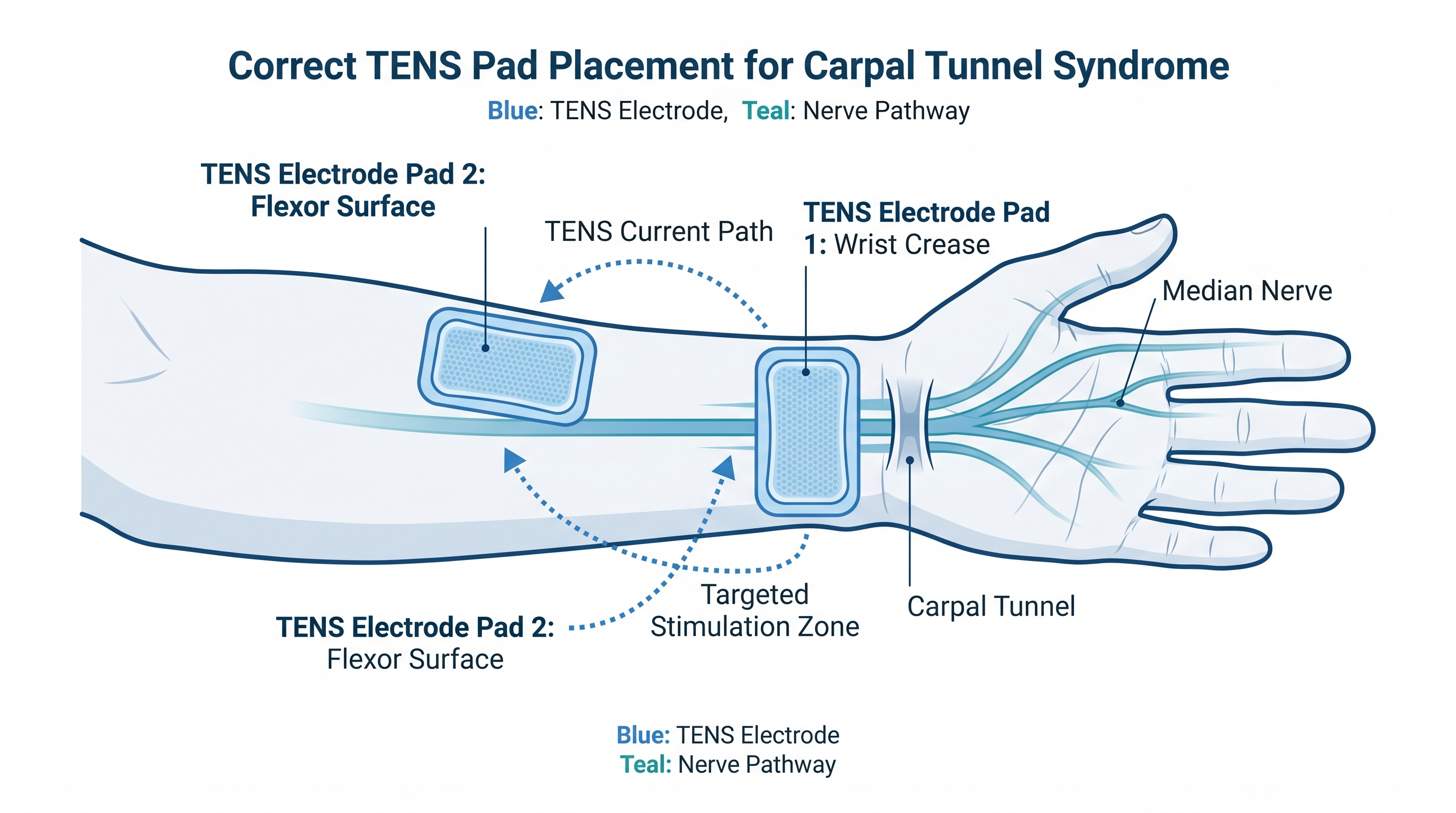
ALT: Diagram showing correct TENS electrode pad placement on inner wrist and forearm for carpal tunnel syndrome pain relief using a TENS device
Advanced Considerations: Maximizing Long-Term Results with TENS
Handling Symptom Variability and Flare-Ups
Carpal tunnel symptoms are notoriously variable — many people experience cyclical flare-ups triggered by specific activities (extended typing, driving, holding a phone), weather changes, or hormonal fluctuations. During acute flare-ups, increasing TENS session frequency to twice daily with high-frequency settings can provide meaningful short-term relief. During milder periods, a maintenance session once daily helps keep baseline pain levels suppressed.
If symptoms suddenly worsen, particularly if you develop new weakness in thumb pinch, rapid progression of hand numbness, or wasting of the thenar muscles, discontinue self-treatment and consult your physician promptly — these signs may indicate severe compression requiring surgical evaluation.
Common Misconceptions About TENS and Carpal Tunnel
"TENS will cure my carpal tunnel." This is a misunderstanding worth addressing directly. TENS is a symptom management tool — it does not reverse the structural narrowing of the carpal tunnel or decompress the median nerve. Its value lies in reducing pain intensity, improving functional comfort, and potentially reducing reliance on pharmaceutical pain management. For lasting resolution of moderate-to-severe CTS, structural interventions remain necessary.
"More intensity means better results." Higher intensity does not necessarily equal better relief. Many users overstimulate and experience discomfort or skin irritation. The therapeutic range for CTS TENS is a comfortable, strong tingling — not a painful buzz.
"I need a prescription-level device." Professional-grade TENS devices designed for home use — such as those manufactured to ISO-certified standards — deliver clinical-quality stimulation parameters. The science behind endorphin release during TENS therapy, explored in depth in our article The Science Behind Endorphin Release During TENS Therapy, confirms that appropriately designed consumer-grade devices can activate the same neurological pain-relief pathways as clinical machines.
Skin Care and Electrode Maintenance
Skin integrity is a priority for anyone using TENS regularly. After each session, inspect the treatment area for redness, irritation, or small abrasions. If mild redness persists beyond 30 minutes post-session, reduce intensity and ensure pads are fully adhered before future sessions. Rotate pad placement slightly with each session to avoid cumulative skin stress. Store pads in their original packaging or a sealed container to preserve adhesive quality.
Frequently Asked Questions FAQ
Q1: How long does it take to feel relief from using a TENS unit for carpal tunnel syndrome?
Many users notice symptom relief during the first session, typically within 10–15 minutes of beginning stimulation. However, cumulative benefits — including reduced baseline pain and improved nighttime comfort — generally develop over one to two weeks of consistent daily use. The degree and speed of relief vary based on CTS severity, electrode placement accuracy, and settings optimization. Starting at appropriate frequency settings and maintaining consistency are the most reliable predictors of positive outcomes.
Q2: Is it safe to use a TENS unit for carpal tunnel every day?
For most people with CTS, daily TENS use is safe and well-tolerated when following standard guidelines — sessions of 20–30 minutes, with at least one hour between sessions, and proper skin inspection after each use. ISO-certified, professional-grade TENS devices designed for home use are engineered for regular use safely. Always consult your healthcare provider if you have underlying conditions such as diabetes-related peripheral neuropathy, as nerve sensitivity may affect appropriate settings.
Q3: How do I know if my electrode placement for carpal tunnel TENS is correct?
Correct placement should produce a tingling or buzzing sensation that you can feel in the wrist and hand — particularly along the thumb, index, and middle finger distribution of the median nerve. If you feel sensation primarily on the skin surface only, or in an area outside the symptomatic zone, reposition the pads slightly. The inner wrist crease paired with a mid-forearm placement is the most reliably effective starting configuration for most CTS sufferers.
Summary
Using a TENS unit for carpal tunnel syndrome represents a practical, evidence-informed strategy for managing one of the most common and disruptive nerve compression conditions. Three core takeaways from this guide:
- Proper electrode placement is everything. The inner wrist crease to mid-forearm placement creates an electrical pathway directly engaging the median nerve, delivering targeted relief where you need it most.
- Frequency and intensity settings matter. High-frequency settings address acute tingling and immediate pain; low-frequency and burst modes build toward longer-lasting endorphin-mediated relief. Neither mode should ever produce discomfort.
- TENS works best as part of a broader management strategy. Combined with ergonomic adjustments, nerve gliding exercises, and appropriate nighttime splinting, TENS therapy becomes a powerful pillar of your CTS self-care routine.
For individuals committed to reducing their reliance on pharmaceutical pain relief, investing in a professional-grade, ISO-certified TENS device is one of the most cost-effective and empowering decisions you can make for your long-term wrist health.
Ready to Take the Next Step Toward Drug-Free Carpal Tunnel Relief?
Ready to take control of your pain relief and muscle recovery — naturally and drug-free? Explore iStim's full range of professional-grade TENS, EMS, and Kegel devices at https://istim.com/ and find the right solution tailored to your wellness needs. Join over 20,000 satisfied customers who have made iStim their trusted partner in at-home electrotherapy.
References
- National Institute of Neurological Disorders and Stroke (NINDS). "Carpal Tunnel Syndrome Fact Sheet."
https://www.ninds.nih.gov/health-information/patient-caregiver-education/fact-sheets/carpal-tunnel-syndrome-fact-sheet - American Academy of Orthopaedic Surgeons (AAOS). "Carpal Tunnel Syndrome."
https://orthoinfo.aaos.org/en/diseases--conditions/carpal-tunnel-syndrome - U.S. National Library of Medicine, MedlinePlus. "TENS: Transcutaneous Electrical Nerve Stimulation."
https://medlineplus.gov/ency/article/007459.htm - American Physical Therapy Association (APTA). "Physical Therapy Guide to Carpal Tunnel Syndrome."
https://www.choosept.com/guide/physical-therapy-guide-carpal-tunnel-syndrome - National Center for Biotechnology Information (NCBI/PubMed). "Transcutaneous electrical nerve stimulation (TENS) for pain management in carpal tunnel syndrome."
https://pubmed.ncbi.nlm.nih.gov/
Note: Standards and clinical guidelines may be updated. Please check the latest official documents or consult a qualified healthcare professional for current recommendations.
About iStim
iStim is a Los Angeles-based electrotherapy brand specializing in professional-grade TENS, EMS, and Kegel devices engineered for safe, effective home use — backed by ISO-certified Taiwanese manufacturing and trusted by 20,000+ Amazon customers for drug-free pain relief and muscle stimulation. Learn more at istim.com.
© iStim. All rights reserved. This article is intended for informational purposes only and does not constitute medical advice. Always consult a qualified healthcare professional before beginning any electrotherapy or treatment program.
About iStim
iStim is a Los Angeles-based electrotherapy brand specializing in professional-grade TENS, EMS, and Kegel devices engineered for safe, effective home use — backed by ISO-certified Taiwanese manufacturing and trusted by 20,000+ Amazon customers for drug-free pain relief and muscle stimulation. Learn more at istim.com.
© iStim. All rights reserved. This article is intended for informational purposes only and does not constitute medical advice. Always consult a qualified healthcare professional before beginning any electrotherapy or treatment program.
Leave a comment