

TENS Therapy for Arthritis: Which Settings Work Best for Joint Pain Relief

ALT: Person using TENS unit for arthritis joint pain relief with electrode pads on knee
TENS Therapy for Arthritis: A Drug-Free Path to Joint Pain Relief
Key Conclusion: TENS therapy for arthritis offers a clinically supported, drug-free method to reduce joint pain by delivering gentle electrical impulses that interrupt pain signals and stimulate natural endorphin release. When used with the right frequency, intensity, and electrode placement, a quality TENS unit can provide meaningful relief for osteoarthritis, rheumatoid arthritis, and other inflammatory joint conditions — making it an increasingly popular home-based alternative to daily pain medications.
Living with arthritis means navigating a daily negotiation with your own body. Whether it's the stiffness in your fingers each morning or the aching knees that make climbing stairs feel like a challenge, arthritis pain is relentless and deeply personal. More and more health-conscious adults are seeking non-pharmaceutical approaches — and TENS therapy (Transcutaneous Electrical Nerve Stimulation) has emerged as one of the most accessible, evidence-informed options available without a prescription.
This guide walks you through how TENS works for arthritis, which settings tend to deliver the best results, and how to safely use a professional-grade TENS device at home. If you've been wondering whether electrotherapy belongs in your pain management toolkit, keep reading.
Who Can Benefit From TENS for Arthritis — and Who Should Be Cautious
✅ Applicable Scenarios:
- Adults with osteoarthritis in the knees, hips, hands, or spine seeking daily pain management support
- Individuals with rheumatoid arthritis looking for drug-free relief during flares or to complement existing treatment
- Post-surgical or post-injury patients recovering joint function and managing residual pain
- Older adults wanting a safe, non-invasive method to reduce reliance on NSAIDs or opioids
- Active individuals experiencing joint soreness after exercise who want faster recovery
❌ Not Applicable/Cautions:
- Individuals with implanted electronic devices such as pacemakers or defibrillators — electrical stimulation may interfere with device function
- Those with broken skin, open wounds, or active infections at or near the electrode placement site
- People with deep vein thrombosis (DVT) or circulatory disorders in the affected limb
- Pregnant individuals, unless specifically cleared by a healthcare provider
- Anyone who has not first consulted a physician about their arthritis diagnosis and treatment plan
Understanding Arthritis Pain and Why TENS Offers a Meaningful Solution
Arthritis affects an estimated 58.5 million adults in the United States alone, according to the Centers for Disease Control and Prevention (CDC). It is one of the leading causes of disability in the country, with osteoarthritis (OA) and rheumatoid arthritis (RA) being the two most common forms. The hallmark symptom — joint pain — stems from a combination of cartilage degradation, inflammatory responses, and sensitized nerve pathways that amplify pain signals over time.
Conventional management often involves NSAIDs, corticosteroids, or in advanced cases, surgical intervention. While these approaches are sometimes necessary, they carry well-documented side effects, particularly with long-term use. This has driven growing demand for electrotherapy solutions that address pain at the neurological level without systemic drug exposure.
TENS therapy works by sending low-voltage electrical currents through the skin via self-adhesive electrode pads placed near or around the painful joint. These impulses travel along sensory nerve fibers and work through two primary mechanisms: the gate control theory — where non-painful electrical signals "close the gate" to pain transmission in the spinal cord — and endorphin release, where specific frequencies stimulate the body's natural opioid system to produce endogenous pain-relieving chemicals.
Clinical studies and systematic reviews have consistently noted TENS as a valuable adjunct therapy for arthritis pain. The Arthritis Foundation recognizes TENS as a non-drug pain management strategy, and many physical therapists incorporate it into rehabilitation protocols for arthritic patients. For home users, professional-grade devices like those offered by iStim bring this clinical-quality technology within reach — without requiring a clinic visit or prescription.
The key, however, is not simply owning a TENS unit — it's knowing how to configure it effectively for joint pain. Settings matter enormously, and that's what we'll explore in depth in the next section.
How to Use TENS for Arthritis: Settings, Placement, and Best Practices
Three-Step Quick Start for Arthritis Relief
Step 1: Position Your Electrode Pads Correctly
Proper electrode placement is the foundation of effective TENS therapy. For arthritic joints, pads should be placed on either side of the affected joint — not directly over bone. For knee arthritis, place one pad on the medial (inner) side and one on the lateral (outer) side of the knee, or above and below the joint. For hip pain, pads typically go on the muscle tissue surrounding the joint. Avoid placing electrodes over areas with reduced sensation or directly on bony prominences. Clean, dry skin ensures better adhesion and conductivity, improving the quality of the electrical signal.
Step 2: Select the Right Frequency and Intensity
For arthritis pain, two frequency ranges are most commonly recommended based on clinical literature:
- High frequency (80–120 Hz): Activates the gate control mechanism for faster, more immediate relief. This is ideal for acute flares or managing pain during activity. Use this setting first if you're new to TENS.
- Low frequency (2–10 Hz): Triggers endorphin release for longer-lasting, deeper relief. Best for chronic, background joint pain. Note that this setting may take 20–40 minutes to feel the full effect.
Intensity should be set to a level that feels like a strong but comfortable tingling — never sharp, burning, or painful. Start low and gradually increase until you reach the therapeutic window. Most users find their effective intensity within a few adjustments.
Step 3: Run Your Session and Monitor Your Response
A typical TENS session for arthritis lasts 20 to 30 minutes. You can use TENS up to several times per day, though it's wise to allow skin rest between sessions and consult your healthcare provider about session frequency for your specific condition. Keep a simple log of your pain levels before and after each session using a 1–10 scale — this helps you identify which settings and placements work best for your body over time. If pain worsens or you experience skin irritation, discontinue use and consult a professional.
Comparing TENS Settings for Different Types of Arthritis Pain
Understanding which settings align with your arthritis type and symptom pattern can significantly improve outcomes. The table below provides a general comparison based on commonly used electrotherapy protocols:
| Comparison Dimension | High-Frequency TENS (80–120 Hz) | Low-Frequency TENS (2–10 Hz) | Burst Mode TENS |
|---|---|---|---|
| Primary Mechanism | Gate control — blocks pain signals | Endorphin release | Combines both mechanisms alternately |
| Best For | Acute flares, activity-related pain | Chronic background aching | Patients who plateau on single mode |
| Onset of Relief | Rapid (within minutes) | Slower (20–40 minutes) | Moderate |
| Duration of Effect | Shorter-lasting | Longer-lasting post-session | Variable |
| Recommended For | OA during movement, RA flare management | Persistent daily aching joints | Mixed or complex arthritis presentations |
| Tolerance Risk | Moderate with repetitive use | Lower | Lower — variation helps prevent adaptation |
Most professional TENS devices, including those in the iStim range, offer multiple frequency modes and adjustable intensity levels — giving you the flexibility to shift between protocols based on how your joints feel each day.
Best Practices for Electrode Placement and Safe TENS Use at Home
Understanding safe TENS unit placement and electrode positioning is as important as choosing the right frequency. Poor placement leads to ineffective sessions, skin irritation, and — in rare cases — mild discomfort. Here's a closer look at joint-specific guidance:
Knee Arthritis
The knee is the most commonly treated joint with TENS. Place electrodes on either side of the kneecap (patella), or above and below it along the quadriceps tendon and patellar ligament. If pain is concentrated on one side — medial or lateral — position one pad closer to the pain source.
Hand and Finger Joints (Rheumatoid Arthritis)
Small joints present a unique challenge. Use smaller electrode pads and place them on the dorsal (top) and palmar (bottom) surfaces of the hand, or on the forearm closer to the wrist for broader coverage. Avoid placing electrodes between individual fingers.
Hip and Lower Back Arthritis
Hip arthritis often radiates to the lower back or thigh. For hip joint pain, place pads on the gluteal muscles and upper outer thigh. For spinal arthritis, electrodes go on the paraspinal muscles flanking the spine — never on the spine itself.
General Safety Principles
Never place TENS electrodes across the chest (heart region), over the carotid sinus on the neck, directly on the head or face, or over broken skin or rashes. Always use medical-grade electrode pads rated for the device in use, and replace them when they lose adhesion — poor contact leads to inconsistent delivery and potential skin irritation.
Many users ask whether it's safe to use an electrical stimulation device regularly over the long term. For healthy adults following appropriate placement and intensity guidelines, TENS is generally considered very safe for regular use. The non-invasive nature of the therapy means there is no systemic exposure, and no risk of tolerance in the way oral pain medications present.
Practical Example: Managing Morning Stiffness With TENS
Consider someone in their late 50s with moderate knee OA who experiences significant stiffness and aching upon waking. Starting a 20-minute high-frequency TENS session shortly after rising — while the joint is warming up — can help interrupt the early-morning pain cycle, making movement more comfortable throughout the day. Over time, adding low-frequency evening sessions may extend the duration of relief between waking and the next episode of significant pain.
This kind of layered, personalized approach is exactly what makes TENS such a flexible tool for arthritis management.
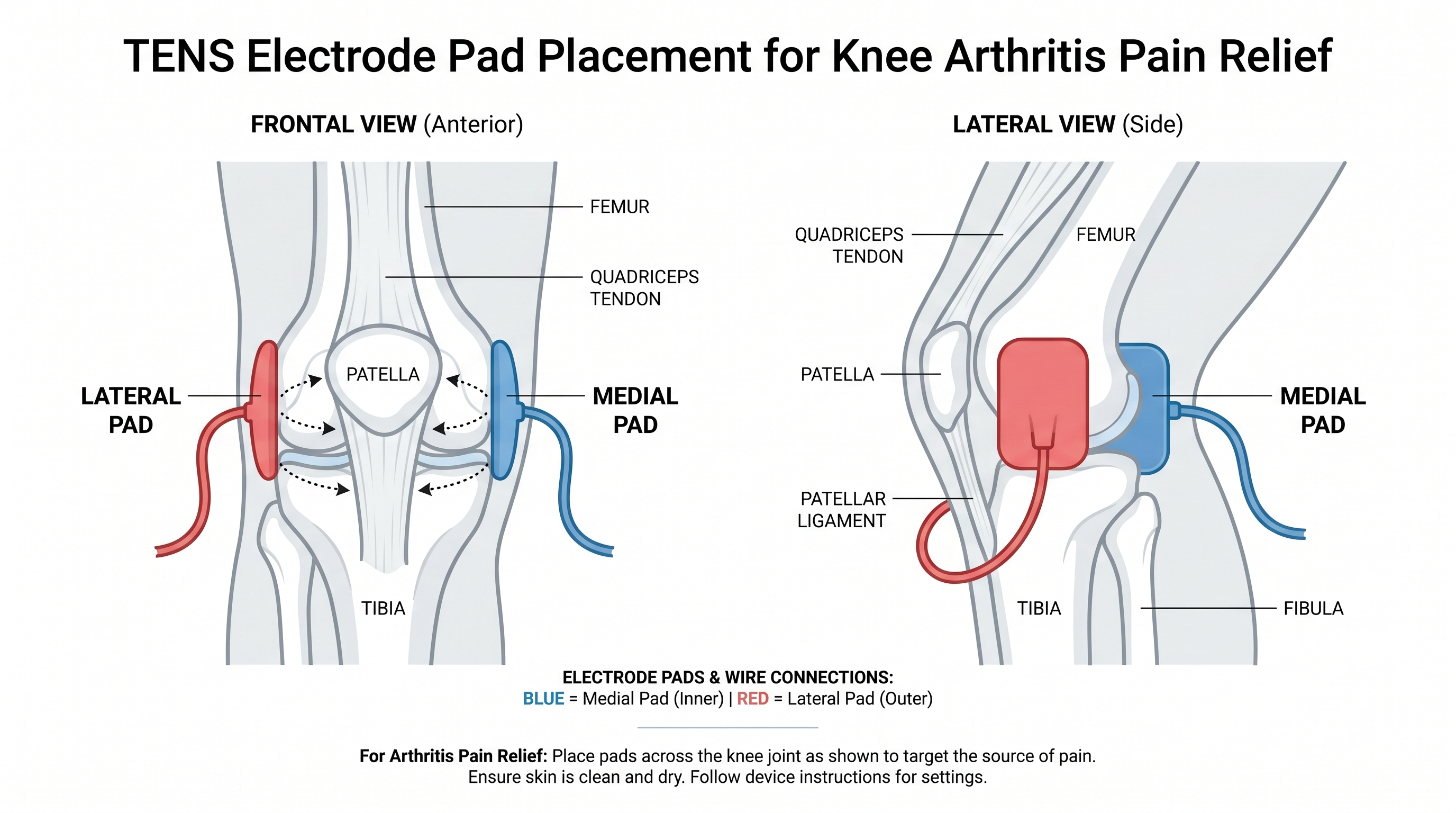
ALT: Diagram showing correct TENS electrode pad placement on knee for arthritis joint pain relief therapy
Advanced Considerations: Getting More From Your TENS Therapy
When Standard Settings Aren't Enough
Some arthritis patients find that their initial TENS protocol stops producing consistent results after weeks of regular use. This is known as accommodation — the nervous system adapts to repetitive stimulation. The solution is straightforward: vary your settings. Alternate between high-frequency and low-frequency modes across sessions, try burst mode if available, or shift electrode placement slightly to engage different nerve pathways.
Combining TENS With Other Drug-Free Modalities
TENS is rarely a standalone solution for advanced arthritis — it works best as part of a broader, integrative approach. Pairing TENS with EMS (Electrical Muscle Stimulation) can be particularly effective for arthritic joints surrounded by weakened supporting muscles. While TENS addresses pain, EMS strengthens the muscles that stabilize the joint, reducing mechanical stress and slowing cartilage degradation over time.
If you're evaluating between TENS and EMS devices — or wondering which is the better buy — consider this: TENS is primarily for pain relief, while EMS is primarily for muscle strengthening and recovery. For arthritic patients, both can be valuable, and many professional-grade devices offer dual functionality. iStim's device range is designed to meet both needs at a clinical standard accessible for home use.
Clearing Up Common Misconceptions
"More intensity means more relief." This is a frequent misconception. TENS works within a therapeutic intensity window — strong tingling, not pain. Exceeding this does not improve outcomes and may cause skin irritation or muscle contraction that worsens joint discomfort.
"TENS permanently fixes arthritis." TENS is a pain management tool, not a curative therapy. It does not reverse cartilage loss or halt disease progression, but it can meaningfully improve quality of life and reduce the need for medication during pain episodes.
"TENS works the same for everyone." Individual responses vary significantly depending on arthritis type, severity, nerve sensitivity, skin conductivity, and placement accuracy. It's worth experimenting with settings over several sessions before judging effectiveness.
Frequently Asked Questions About TENS for Arthritis
Q1: How often should I use a TENS unit for arthritis pain relief?
Most physical therapists recommend TENS sessions of 20–30 minutes, up to two to three times per day for arthritis, depending on severity. Consistency matters more than duration — daily use tends to produce better cumulative results than occasional sessions. Always allow the skin to rest between sessions and check for any signs of irritation. If you're new to TENS, start with once daily and gradually increase based on how your body responds. Consult your healthcare provider for a personalized frequency recommendation.
Q2: Is TENS therapy safe to use alongside arthritis medications?
For most people, TENS is safe to use concurrently with common arthritis medications including NSAIDs, DMARDs, and corticosteroids, as it operates through a completely non-pharmacological mechanism. However, if you are taking blood thinners, have significant cardiovascular conditions, or are undergoing chemotherapy, consult your physician before beginning TENS therapy. TENS does not interact chemically with medications, but your overall health picture matters when determining appropriate use.
Q3: How long does it take to notice results from TENS therapy for joint pain?
Results vary by individual and arthritis type. Many users experience noticeable pain reduction within the first one to three sessions, particularly with high-frequency settings that activate the gate control mechanism rapidly. Deeper, longer-lasting relief from low-frequency endorphin-stimulating sessions may take one to two weeks of consistent use to fully appreciate. Keeping a pain journal helps track progress objectively. If no improvement is observed after two to three weeks of consistent use, consult a physical therapist for a more tailored protocol.
Summary
TENS therapy represents one of the most well-supported, accessible, and genuinely practical tools for managing arthritis joint pain without relying solely on medications. Three core takeaways from this guide:
- Settings are everything — high-frequency TENS (80–120 Hz) provides fast, gate-control-based relief ideal for flares and activity, while low-frequency (2–10 Hz) delivers endorphin-driven relief better suited for chronic daily aching. Matching your setting to your symptom pattern dramatically improves outcomes.
- Placement accuracy is non-negotiable — electrodes positioned correctly around (not on) arthritic joints, on clean and dry skin, ensure effective signal delivery and minimize discomfort or skin irritation.
- Consistency and personalization drive results — TENS works best as part of a routine, ideally combined with supporting modalities like EMS for muscle strengthening, and adjusted over time as your body and symptoms evolve.
Your next step is straightforward: choose a professional-grade TENS device engineered for consistent, reliable performance — one backed by real clinical principles and designed for everyday home use.
Ready to Take the Next Step?
Ready to experience drug-free pain relief and muscle recovery from the comfort of your home? Explore iStim's full range of professional-grade TENS, EMS, and Kegel devices at https://istim.com/ and find the right solution tailored to your wellness needs. Join over 20,000 satisfied customers who trust iStim to deliver clinically inspired electrotherapy — safely, effectively, and affordably.
References
- Centers for Disease Control and Prevention (CDC). "Arthritis — Data and Statistics."
https://www.cdc.gov/arthritis/data_statistics/index.htm - Arthritis Foundation. "Transcutaneous Electrical Nerve Stimulation (TENS) for Arthritis Pain."
https://www.arthritis.org/health-wellness/treatment/complementary-therapies/physical-interventions/tens - National Institute of Neurological Disorders and Stroke (NINDS). "Pain: Hope Through Research."
https://www.ninds.nih.gov/health-information/patient-caregiver-education/hope-through-research/pain-hope-through-research - Johnson M.I. "Transcutaneous Electrical Nerve Stimulation (TENS) as an Adjunct for Pain Management in Perioperative Settings." Journal of Pain Research. National Library of Medicine.
https://www.ncbi.nlm.nih.gov/pmc/articles/PMC6233698/ - American College of Rheumatology. "Osteoarthritis — Non-Pharmacological Treatment Options."
https://www.rheumatology.org/I-Am-A/Patient-Caregiver/Diseases-Conditions/Osteoarthritis
Note: Standards and clinical guidelines may be updated. Please check the latest official documents or consult a qualified healthcare professional for the most current recommendations.
About iStim
iStim is a Los Angeles-based electrotherapy brand specializing in professional-grade TENS, EMS, and Kegel devices engineered for home use, backed by ISO-certified Taiwanese manufacturing and trusted by 20,000+ customers for safe, drug-free pain relief and muscle stimulation. Learn more at istim.com.
Disclaimer: This article is provided for informational and educational purposes only and does not constitute medical advice. The content is not intended to diagnose, treat, cure, or prevent any medical condition. Always consult a qualified healthcare professional before beginning any new therapy or treatment program. © iStim. All rights reserved.
Leave a comment