

Manual Kegels vs EMS Kegel Trainer: Which Is Better?

ALT: Woman at home comparing manual Kegel exercises vs EMS Kegel trainer for pelvic floor training
Manual Kegels vs EMS Kegel Trainer: Understanding Your Options for Pelvic Floor Health
Key Conclusion: When comparing manual Kegels vs EMS Kegel trainers, neither is universally superior — but each excels in different situations. Manual Kegels are free, accessible, and effective for those who can correctly identify and contract their pelvic floor muscles. EMS Kegel trainers, on the other hand, deliver targeted electrical muscle stimulation that removes guesswork, ensures proper muscle engagement, and can accelerate results — particularly for women recovering from childbirth, managing incontinence, or struggling to feel and isolate pelvic floor muscles on their own.
Pelvic floor health affects millions of women and men worldwide, yet it remains one of the most under-discussed aspects of wellness. Whether you're navigating postpartum recovery, managing stress urinary incontinence, or simply looking to maintain long-term pelvic function, the question of how to train is just as important as whether to train.
Two primary approaches dominate today's landscape: the time-tested practice of manual Kegel exercises and the increasingly popular EMS (Electrical Muscle Stimulation) Kegel trainer. Understanding the real differences — clinically, practically, and in terms of results — empowers you to make the right choice for your body and lifestyle.
Who Should Read This Guide?
✅ Applicable Scenarios:
- Women experiencing mild to moderate urinary incontinence or pelvic floor weakness after childbirth or menopause
- Individuals who have tried manual Kegels but are unsure whether they are engaging the correct muscles
- Fitness-conscious adults seeking a structured, measurable approach to pelvic floor training at home
- Anyone interested in drug-free, non-invasive pelvic floor rehabilitation without frequent clinic visits
❌ Not Applicable/Cautions:
- Individuals with active pelvic infections, open wounds, or implanted electronic devices (such as pacemakers) — EMS devices are contraindicated; consult your physician first
- Those experiencing severe pelvic organ prolapse or significant pelvic pain — a qualified pelvic floor physiotherapist should be consulted before beginning any self-directed program
- Pregnant women should seek medical guidance before using internal EMS devices
Why Pelvic Floor Training Is Getting Serious Attention
The pelvic floor is a group of muscles, ligaments, and connective tissues forming the base of the pelvis. These muscles support the bladder, bowel, and uterus — and when they weaken, the consequences range from embarrassing (leaking when you sneeze or laugh) to genuinely debilitating (pelvic organ prolapse or chronic pelvic pain).
The numbers are striking. According to the National Institutes of Health, nearly one in three women experiences a pelvic floor disorder at some point in her life. Urinary incontinence alone affects hundreds of millions of people globally, and postpartum pelvic floor weakness is nearly universal among women who have given birth vaginally.
For decades, the standard recommendation has been simple: do your Kegels. Kegel exercises — named after gynecologist Dr. Arnold Kegel, who popularized them in the 1940s — involve voluntarily contracting and releasing the pelvic floor muscles to build strength and endurance. They're free, discreet, and supported by decades of clinical evidence.
But there's a persistent problem: a significant proportion of people who are instructed to do Kegels are actually doing them wrong. Research suggests that as many as 30–50% of women cannot correctly perform a voluntary pelvic floor contraction without guidance. They may be bearing down instead of lifting up, holding their breath, or engaging their glutes and inner thighs instead of the pelvic floor itself.
This is where EMS Kegel trainers enter the conversation. Rather than relying on the user to identify and volitionally contract a muscle group that many people genuinely cannot feel, these devices deliver precise electrical impulses that cause the pelvic floor muscles to contract automatically — no guesswork required.
For a deeper overview of how these two approaches compare specifically for women's needs, the guide on Best Kegel Trainer for Women: EMS vs Manual Kegels offers an excellent starting point.
Breaking Down the Comparison: Manual Kegels vs EMS Kegel Trainer
Getting Started: A Three-Step Framework for Choosing the Right Approach
Step 1: Assess Your Body Awareness
Before choosing between manual Kegels and an EMS device, honestly evaluate whether you can feel and control your pelvic floor muscles. Lie down and attempt to tighten the muscles you would use to stop the flow of urine mid-stream (though avoid practicing on the toilet). If you feel a clear lift-and-squeeze sensation without tensing your abdomen, buttocks, or thighs, manual Kegels may work well for you. If you're uncertain, an EMS trainer may provide the biofeedback and assisted contraction you need.
Step 2: Define Your Primary Goal
Are you focused on preventing future weakness, recovering from childbirth, managing active leakage, or rebuilding strength after a long gap in training? Preventive and maintenance goals often align well with consistent manual exercise. Active rehabilitation — particularly for incontinence or post-delivery recovery — tends to benefit more from the structured, consistent contractions that EMS devices deliver, removing the error variable entirely.
Step 3: Consider Your Lifestyle and Commitment Level
Manual Kegels require daily discipline, correct form, and ongoing self-monitoring — with no way to verify you're doing them right unless you work with a pelvic floor therapist. An EMS Kegel trainer automates the contraction cycle and lets you read, relax, or engage in light activity during sessions. If consistency has been a barrier for you in the past, the structured nature of EMS training often produces better real-world adherence.
Head-to-Head: Manual Kegels vs EMS — A Comprehensive Comparison
Both approaches share the same fundamental goal — strengthening the pelvic floor muscles — but they differ substantially in how they achieve it, who benefits most, and what the user experience looks like day to day.
| Comparison Dimension | Manual Kegels | EMS Kegel Trainer | Best For |
|---|---|---|---|
| Ease of correct execution | Difficult for ~30–50% of users | Automatic — device does the work | Beginners or those with poor body awareness |
| Muscle targeting precision | Variable — depends on user technique | High — electrical stimulus targets pelvic floor directly | Rehabilitation and incontinence management |
| Cost | Free | One-time device investment | Budget-conscious vs results-focused users |
| Time per session | 5–15 minutes, multiple times daily | Typically 15–30 minutes per session | Those with limited time prefer EMS structure |
| Measurable progress | Subjective — user feels improvement | Objective — programmable intensity levels | Those who need tangible feedback |
| Portability | Fully portable — no equipment needed | Compact device needed | Travel-friendly edge goes to manual |
| Suitable for severe weakness | Limited — requires some voluntary control | Effective even with minimal voluntary control | Post-surgical or postpartum users |
| Learning curve | High — technique is everything | Low — device guides the process | First-time users benefit from EMS |
A Deeper Look at Each Approach
The Case for Manual Kegels
Manual Kegel exercises remain the foundation of pelvic floor training for good reason. When performed correctly and consistently, they build genuine neuromuscular control — not just muscle strength, but the mind-muscle connection that allows you to engage your pelvic floor reflexively, such as when you cough, sneeze, or lift something heavy.
The mechanism is straightforward: you contract the pelvic floor muscles, hold the contraction for several seconds, then release fully. Over weeks and months, this repeated pattern strengthens the slow-twitch endurance fibers responsible for maintaining continence and pelvic organ support. Progressive variations — including quick-flick contractions to train fast-twitch fibers — add further functional benefit.
The advantages are compelling. Manual Kegels are free, require no equipment, can be done anywhere, and carry essentially no risk when performed correctly. They're supported by decades of peer-reviewed research, endorsed by major medical organizations including the American College of Obstetricians and Gynecologists, and are often the first-line recommendation from pelvic floor physiotherapists.
The challenge, however, is consistency and correctness. Without professional guidance or biofeedback, many people train the wrong muscles for weeks or even months before realizing it. There's no built-in correction mechanism. Progress is also difficult to track subjectively — you may be doing everything right and still doubt yourself, or believe you're improving while your technique has plateaued.
The Case for EMS Kegel Training
Electrical Muscle Stimulation (EMS) works on a fundamentally different principle. Rather than asking you to voluntarily contract a muscle you may struggle to feel, the device delivers low-level electrical currents through a probe or electrode that directly cause the pelvic floor muscles to contract rhythmically.
This has several meaningful advantages. First, it bypasses the technique problem entirely — the muscle is contracting whether or not you can feel it or coordinate it voluntarily. Second, it allows consistent, repeatable contraction patterns that can be programmed and progressively intensified over time. Third, it can be effective even in cases of significant muscle weakness, where voluntary contractions would be too feeble to produce a training effect.
For women recovering from childbirth, managing genuine stress or urge incontinence, or dealing with pelvic floor dysfunction following surgery or menopause, EMS training can achieve meaningful results more quickly than manual exercises alone. Many clinical protocols combine EMS with manual Kegels for synergistic benefit — the EMS re-educates the muscle, while voluntary exercises build the conscious control needed for functional daily use.
If you're exploring EMS-based devices, the Best Pelvic Floor Trainer with Adjustable Intensity resource offers practical guidance on what to look for in a quality device — including the importance of programmable intensity levels that allow you to progress safely over time.
Real-World Example: Which Approach Works When?
Consider two different users. The first is a 34-year-old woman who recently gave birth and experiences occasional leakage when sneezing. She's healthy, motivated, and has good body awareness from yoga practice. For her, a committed manual Kegel program — ideally verified by a pelvic floor physiotherapist — may be entirely sufficient with consistent effort.
The second is a 58-year-old woman who has experienced stress incontinence for years, has tried manual Kegels multiple times without noticeable improvement, and isn't sure she's ever correctly engaged her pelvic floor. For her, an EMS Kegel trainer is likely to be significantly more effective, providing the direct stimulation her muscles need to respond and adapt.
Many users ultimately find that combining both approaches — using EMS sessions to train the muscles effectively while practicing voluntary contractions between sessions — delivers the best long-term outcomes.
For those exploring options for pelvic floor training specifically targeted at bladder control routines, structured EMS programs have shown particular promise in clinical and at-home settings alike.
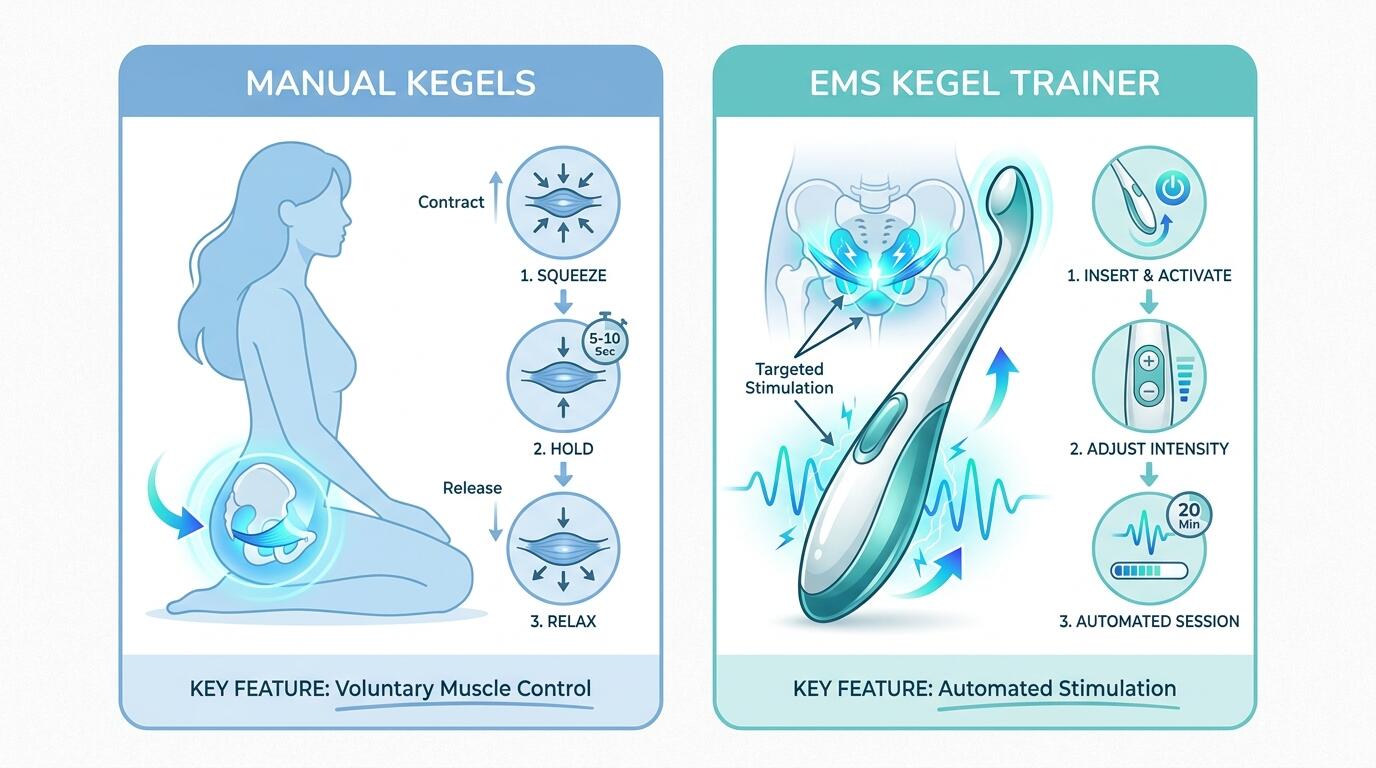
ALT: Side-by-side comparison of manual Kegel exercise technique and EMS Kegel trainer device showing pelvic floor training approaches
Advanced Considerations: Combining Approaches and Avoiding Common Mistakes
When Manual Kegels and EMS Work Together
The question framed as "manual Kegels vs EMS" is, in many ways, a false dichotomy. Pelvic floor physiotherapists increasingly recommend a combined approach: using EMS sessions to establish the muscle memory and stimulate the neuromuscular pathway, while using voluntary manual Kegels to reinforce conscious control throughout the day.
Think of it like physical therapy after a knee injury. The therapist may use electrical stimulation to get weakened muscles firing again — then teach you exercises to maintain and build on that activation independently. The same logic applies to pelvic floor rehabilitation.
Misconceptions to Clear Up
Misconception 1: "If I can't feel anything, EMS isn't working."
Electrical stimulation at therapeutic levels is often subtle. The goal is muscle contraction, not intense sensation. A professionally calibrated device at the right intensity will produce contractions even if you only perceive gentle tingling.
Misconception 2: "Manual Kegels are always safe."
Incorrectly performed Kegels — particularly bearing down or straining — can actually worsen symptoms, especially if pelvic floor muscles are already overactive (hypertonic). If symptoms worsen with manual exercises, consult a pelvic floor specialist before continuing.
Misconception 3: "EMS is a shortcut that replaces real exercise."
EMS is a therapeutic tool, not a substitute for overall pelvic health management. It works best as part of a broader approach that may include lifestyle adjustments, posture awareness, and guided exercise progression.
The Role of Device Quality
Not all EMS Kegel trainers are created equal. Device safety, the quality of electrical waveforms, and the ability to adjust intensity precisely all affect both safety and outcomes. iStim's Kegel devices are built to clinical-grade standards — backed by ISO-certified manufacturing — ensuring that the electrical output is reliable, consistent, and safe for home use. If you're curious about a specific iStim EMS device's suitability for your needs, the iStim V2 Review: Who Is It Best For? provides detailed insight into which users benefit most from this professional-grade option.
Frequently Asked Questions FAQ
Q1: How do I know if I'm doing manual Kegels correctly?
The most reliable way to confirm proper technique is a session with a certified pelvic floor physiotherapist, who can use internal assessment or biofeedback equipment to verify muscle engagement. At home, a basic check is ensuring that only the pelvic floor lifts — not your abdomen, buttocks, or inner thighs. If you notice your belly tightening or you're holding your breath, you're likely compensating with the wrong muscles. This is one of the key reasons many clinicians recommend EMS devices for beginners who cannot yet isolate pelvic floor engagement independently.
Q2: Are EMS Kegel trainers better than manual Kegels for incontinence?
For many people — particularly those with moderate to significant urinary incontinence or poor voluntary muscle control — EMS Kegel trainers can produce more consistent and faster results than manual exercises alone. This is because EMS guarantees the correct muscles are contracting with each session, while manual Kegels depend entirely on user technique. However, "better" depends on your specific situation, severity, and ability to perform voluntary contractions. Consulting a healthcare provider or pelvic floor specialist will help you determine the most appropriate starting point for your individual needs.
Q3: How long does it take to see results from pelvic floor training?
Timelines vary based on baseline muscle strength, training consistency, and the severity of dysfunction. With consistent manual Kegels performed correctly, many people notice early improvements within four to six weeks, with more significant progress over three to six months. EMS training can accelerate the initial phase — particularly for those with weak baseline muscle activity — by establishing contraction patterns more quickly. Either way, pelvic floor training is a long-term commitment, not a quick fix, and maintaining a regular routine after initial improvement is essential for lasting results.
Summary
The debate between manual Kegels vs EMS Kegel training ultimately comes down to your individual needs, body awareness, and goals. Here are the three core takeaways to carry forward:
1. Manual Kegels are effective — when done correctly. They build genuine neuromuscular control, require no equipment, and are supported by extensive clinical evidence. But they require proper technique, consistent practice, and ideally some form of professional guidance to ensure you're training the right muscles.
2. EMS Kegel trainers remove the guesswork. For those who cannot isolate pelvic floor muscles, are recovering from childbirth or surgery, or have not seen results from manual exercises, EMS provides direct, reliable muscle stimulation that produces results even without voluntary contraction ability.
3. Combining both approaches often delivers the best outcomes. Using an EMS device to establish muscle activation and using voluntary Kegel exercises to build on that foundation creates a comprehensive, clinically aligned pelvic floor training program.
Wherever you are in your pelvic floor health journey — whether you're just starting out or looking to accelerate progress after years of inconsistent results — the key is choosing a method you'll actually commit to, using equipment you can trust, and seeking professional guidance when symptoms are significant.
Ready to Elevate Your Pelvic Floor Training?
Ready to take control of your pelvic floor health with professional-grade technology designed for home use? Explore iStim's full lineup of clinical-quality EMS and Kegel devices at https://istim.com/ and find the drug-free solution tailored to your needs. Trusted by over 20,000 customers and built to ISO-certified manufacturing standards, iStim is here to help you move, feel, and live better — every day.
References
- National Institutes of Health (NIH). "Pelvic Floor Disorders."
https://www.nichd.nih.gov/health/topics/pelvicfloor - American College of Obstetricians and Gynecologists (ACOG). "Pelvic Support Problems."
https://www.acog.org/womens-health/faqs/pelvic-support-problems - Bø, K., et al. "Evidence-Based Physical Therapy for the Pelvic Floor." Journal of Physiotherapy. Published via National Library of Medicine.
https://www.ncbi.nlm.nih.gov/pmc/articles/PMC4748948/ - National Association for Continence (NAFC). "Kegel Exercises."
https://www.nafc.org/kegel-exercises - Herbison, G. P., & Dean, N. "Weighted vaginal cones for urinary incontinence." Cochrane Database of Systematic Reviews. Published via Cochrane Library.
https://www.cochranelibrary.com/cdsr/doi/10.1002/14651858.CD002114.pub2/full
Note: Standards and clinical guidelines may be updated. Please consult the latest official documents or a qualified healthcare professional for the most current recommendations.
About iStim
iStim is a Los Angeles-based electrotherapy brand specializing in professional-grade TENS, EMS, and Kegel devices engineered for safe, effective home use — backed by ISO-certified Taiwanese manufacturing and trusted by 20,000+ Amazon customers for drug-free pain relief and muscle stimulation. Learn more at istim.com.
Disclaimer: This article is provided for informational and educational purposes only and does not constitute medical advice. The content is produced in partnership with iStim and reflects general wellness information. Always consult a qualified healthcare professional before beginning any new therapy or treatment program. iStim is not responsible for any actions taken based on the information presented in this article.
Leave a comment