

How to Choose the Right Probe Size for Your Kegel EMS Device

ALT: Woman holding a Kegel EMS probe device while reading sizing guide for pelvic floor stimulation therapy
Why Probe Size Matters More Than You Think in Kegel EMS Therapy
Key Conclusion: Choosing the correct probe size for your Kegel EMS device is one of the most important — and most overlooked — decisions in pelvic floor therapy. The right fit ensures optimal electrode contact with the vaginal or rectal walls, maximizes the effectiveness of electrical muscle stimulation, and minimizes discomfort or risk of injury. Whether you are postpartum, managing urinary incontinence, or simply starting a pelvic floor strengthening routine, probe sizing directly affects your treatment outcomes.
When most people begin exploring Kegel EMS therapy, they focus primarily on device features, intensity settings, or treatment programs. Very few stop to consider that the physical dimensions and design of the probe itself are what make or break the therapy's effectiveness. A probe that is too small may not make sufficient contact with the pelvic floor muscles, resulting in weak or inconsistent stimulation. One that is too large can cause discomfort, tensing of the muscles, and even avoidance of the therapy altogether.
Pelvic floor health is deeply personal, and the anatomy involved varies significantly from person to person. Factors such as childbirth history, age, hormonal changes, and prior surgeries all influence the internal dimensions of the pelvic canal. Understanding these variations — and knowing how they relate to probe selection — empowers you to make a more informed, confident choice for your at-home therapy.
Who Should Read This Guide on Kegel EMS Probe Selection
✅ Applicable Scenarios:
- Postpartum women experiencing pelvic floor weakness or urinary incontinence after childbirth
- Women over 40 noticing changes in bladder control or pelvic muscle tone due to hormonal shifts
- Individuals beginning a pelvic floor rehabilitation program recommended by a physical therapist or OB-GYN
- Those who have previously tried Kegel EMS therapy but found the experience uncomfortable or ineffective, and suspect probe fit may be a contributing factor
- People managing stress urinary incontinence, pelvic organ prolapse (mild stages), or decreased sexual sensation and looking for non-pharmaceutical solutions
❌ Not Applicable/Cautions:
- Individuals who have recently undergone pelvic surgery, episiotomy repair, or who are in the acute healing phase postpartum — probe-based therapy should only resume after clearance from a healthcare provider
- Those with active vaginal or pelvic infections, open wounds, or inflammatory conditions in the pelvic region, where insertion of any device carries infection risk
- Pregnant women, as internal electrical stimulation of the pelvic floor is generally contraindicated during pregnancy
Understanding the Role of the Probe in Kegel EMS Therapy
Kegel EMS (Electrical Muscle Stimulation) devices work by delivering gentle electrical impulses through a probe inserted into the vaginal or rectal canal. These impulses stimulate the pelvic floor muscles to contract and relax rhythmically — mimicking and reinforcing the same muscular action as a voluntary Kegel exercise, but with far greater precision and consistency. This makes EMS-based Kegel training particularly valuable for people who struggle to isolate or activate the pelvic floor muscles on their own.
The probe acts as the delivery mechanism for these electrical impulses. It houses the electrodes — conductive surfaces that must make direct, stable contact with the vaginal or rectal walls for the electrical current to flow efficiently to the target muscle tissue. If the electrode contact is poor — whether due to incorrect probe size, improper insertion depth, or inadequate coupling — the stimulation will be uneven, weakened, or localized to only part of the muscle group.
The pelvic floor is not a single muscle but a complex of multiple layered muscles, including the levator ani group, which supports the bladder, bowel, and uterus. Effective pelvic floor therapy requires stimulation across a wide enough surface area to engage this entire complex. This is why probe diameter, electrode coverage, and insertion length all matter — and why a one-size-fits-all approach rarely delivers optimal results.
If you are new to electrotherapy for pelvic health, you may also find it helpful to understand the broader landscape of EMS as a clinical modality. How EMS Helps Muscles Contract, Recover, and Grow Stronger provides an excellent scientific foundation for understanding why electrical muscle stimulation is so effective at rehabilitating weakened or underactive muscle groups — including those in the pelvic floor.
Market data consistently shows growing adoption of home-use pelvic floor stimulators, driven by increased awareness of pelvic health, post-pandemic preference for home-based therapy, and aging population demographics. But as more devices become available, consumer confusion around probe sizing has become one of the top reasons for therapy abandonment and dissatisfaction. Getting this decision right from the start saves time, discomfort, and money.
How to Choose the Right Probe Size: A Step-by-Step Approach
Three-Step Quick Start for First-Time Users
Step 1: Assess Your Personal Anatomy and Health History
Before examining product specifications, take stock of your personal health history. Have you given birth vaginally? Have you experienced significant hormonal changes such as menopause? Do you have a history of pelvic pain or vaginismus? These factors directly influence which probe size will be most comfortable and effective. If you have had multiple vaginal deliveries, a slightly larger probe may provide better electrode contact. If you experience pelvic pain or are postmenopausal with vaginal atrophy, a smaller, more tapered probe is typically recommended as a starting point. This self-assessment takes roughly five to ten minutes and can save considerable trial and error.
Step 2: Review Probe Sizing Options and Match to Your Anatomy
Once you understand your anatomy and history, compare the probe sizing options available for your device. Most Kegel EMS probes are described in terms of diameter and length. Smaller profiles suit users who are new to internal devices, who have experienced pelvic pain, or who are in early postpartum recovery (after medical clearance). Standard or medium profiles are appropriate for most adult women with no significant pelvic concerns. Larger profiles are typically designed for women who have had vaginal deliveries and find smaller probes provide insufficient electrode contact. Review the product documentation and, when in doubt, start with a smaller size and progress upward as comfort allows.
Step 3: Perform a Comfort Check During Your First Session
During your first session, insert the probe gently and assess for comfort before activating the device. The probe should feel snug but not painful. There should be no sharp pressure, burning sensation, or significant urge to remove it. Once comfortable with placement, begin at the lowest intensity setting and gradually increase. If the stimulation feels one-sided or inconsistent, the probe may not be making full electrode contact — which often indicates a sizing issue. Reassess fit between sessions, and consider consulting your device's user guide or a pelvic floor physical therapist if discomfort persists.
Probe Size Comparison: Small, Standard, and Large Profiles
Selecting the right probe profile is less about finding the "best" option universally and more about finding the best match for your individual anatomy and therapeutic goals. The table below outlines the key comparison dimensions across the three common probe profile categories. Because iStim's specific probe dimensional data is not publicly listed at the specification level in brand materials, the guidance below is based on industry-standard clinical guidance and general product category norms. Always consult your specific product documentation or healthcare provider for precise sizing recommendations.
| Comparison Dimension | Small / Narrow Profile | Standard / Medium Profile | Large Profile |
|---|---|---|---|
| Best suited for | New users, pelvic pain, post-menopause, early postpartum | Most adult women, general pelvic floor strengthening | Post-vaginal delivery, low pelvic muscle tone, need for broader electrode contact |
| Electrode contact quality | May be lower in women with more spacious anatomy | Balanced for most anatomies | Maximized for women with more internal space |
| Comfort level | Higher for sensitive users | Suitable for general use | May require gradual adjustment |
| Recommended intensity start | Very low | Low to moderate | Low, progressing as tolerated |
| Typical therapy goals | Reducing pain, gentle rehabilitation | General strengthening, incontinence management | Post-partum recovery, prolapse support, muscle retraining |
| Probe material | Medical-grade silicone or ABS | Medical-grade silicone or ABS | Medical-grade silicone or ABS |
Detailed Guidance: Matching Probe Size to Your Therapy Goals
Postpartum Recovery and Urinary Incontinence
One of the most common reasons women seek out a Kegel EMS device is to address urinary incontinence after childbirth. The pelvic floor endures significant stretching and trauma during vaginal delivery, and many women find that voluntary Kegel exercises alone are insufficient to restore full muscle function and bladder control. This is especially true in the first year postpartum, when the neuromuscular connection to the pelvic floor may still be partially disrupted.
If you're wondering how often should I use a pelvic floor stimulator during postpartum healing — the general clinical guidance suggests beginning with shorter sessions (often around 15–20 minutes) performed every other day, with frequency increasing as tolerance and muscle response improve. However, starting too soon after delivery — or using a probe that is too large during sensitive tissue recovery — can set back progress. A smaller or more tapered probe is usually recommended in early postpartum use to reduce discomfort and accommodate healing tissues.
For a comprehensive look at the causes and treatment options for Urinary Incontinence After Childbirth, iStim's dedicated guide offers evidence-based context that can help you understand why probe-based EMS is often recommended by physical therapists as part of a structured recovery plan.
Women Over 40 and Hormonal Changes
Estrogen decline during perimenopause and menopause leads to thinning and increased sensitivity of vaginal tissue — a condition known as vaginal atrophy or genitourinary syndrome of menopause (GSM). This significantly affects probe comfort and sizing. Women in this demographic often find that a standard-sized probe that would have been comfortable in earlier years now feels too large or causes irritation.
Starting with a smaller probe and using a water-based lubricant specifically recommended for use with medical devices is generally advisable. Gradually working toward a standard size as comfort improves — and continuing to monitor tissue response — helps make therapy sustainable. Pelvic Floor Health for Women Over 40 is an excellent resource that explains the specific physiological changes involved and how they should inform your therapy approach.
Athletes and High-Intensity Users
Athletes — particularly those who engage in high-impact sports like running, CrossFit, or gymnastics — often experience pelvic floor dysfunction from a different direction than postpartum women. Rather than weakness from overstretching, athletic pelvic floor issues often involve hypertension (excessive tightness) or incoordination of the pelvic muscles. In these cases, a smaller or medium probe size is typically recommended, with therapy programs focused on relaxation and coordination rather than pure strengthening.
If you are an athlete already familiar with EMS for muscle recovery in other parts of the body, you may also find the guide on EMS for Athletes: How Professional Sports Teams Use Electrical Muscle Stimulation useful for understanding how the same foundational principles apply to pelvic floor training.
Setting Up Your iStim Kegel Device
If you are using an iStim Kegel EMS device and want a thorough walkthrough of the setup and usage process — including how to handle and insert the probe correctly — the How to Use the iStim V2 Kegel Exerciser: A Complete Setup and Usage Guide is the definitive resource. Proper insertion technique is almost as important as probe size selection — a correctly sized probe inserted at the wrong angle or depth will still underperform.
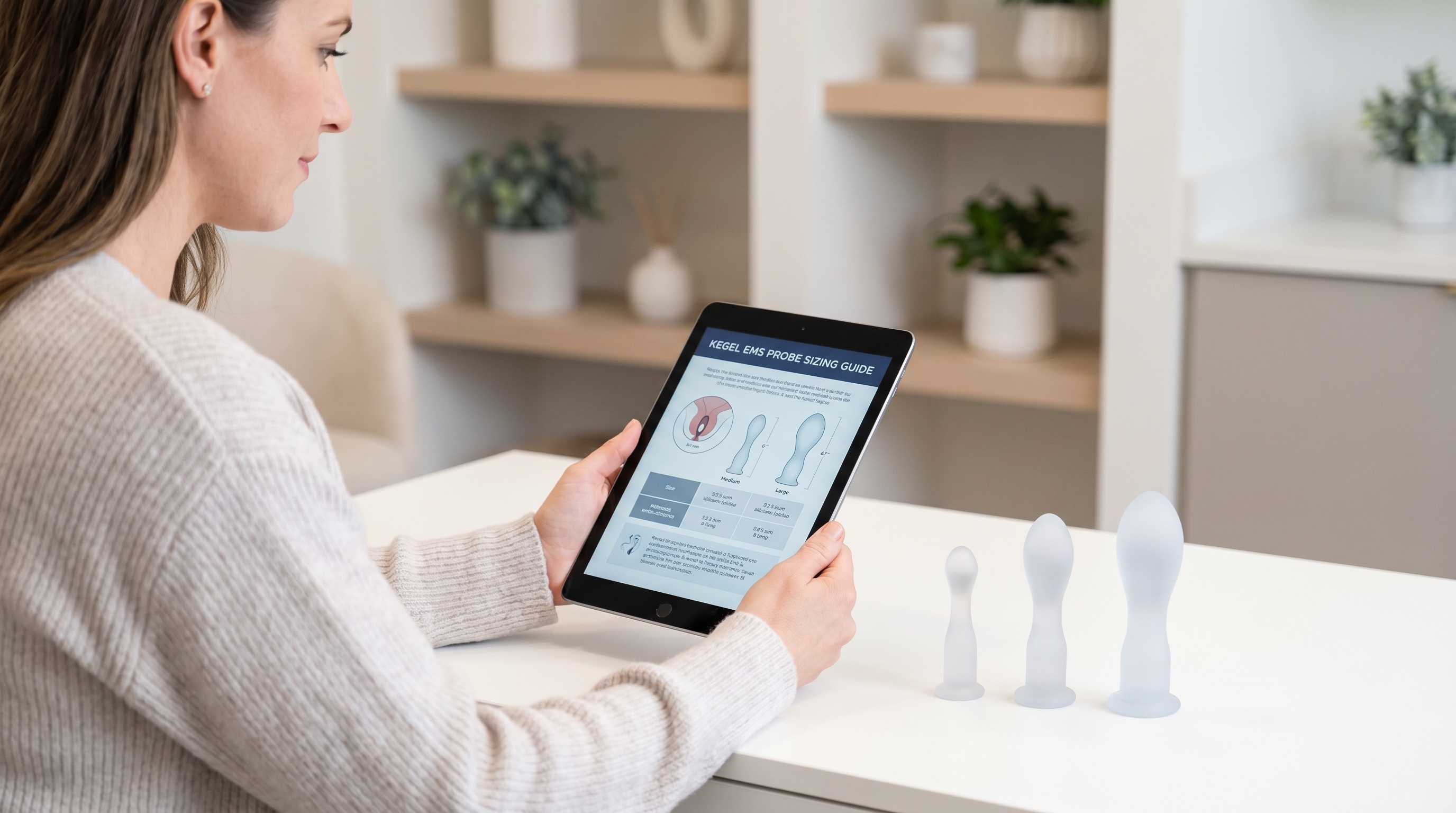
ALT: Woman comparing Kegel EMS probe sizes for pelvic floor stimulator device to find the best fit for therapy
Advanced Considerations: Special Situations and Common Misconceptions
Special Situation 1: Using a Probe After Pelvic Surgery or Prolapse
Women who have undergone surgical repair for pelvic organ prolapse, stress urinary incontinence slings, or other pelvic reconstructions should always obtain explicit clearance from their surgeon before using any internal pelvic floor device. The healing tissue, mesh materials, or altered anatomy can interact unpredictably with electrical stimulation. When cleared for use, starting with the smallest available probe and the lowest intensity settings is essential.
Special Situation 2: Rectal Probe Use for Men and Some Women
While this guide primarily addresses vaginal probe use, rectal probes are also available for Kegel EMS therapy — particularly relevant for men managing post-prostatectomy incontinence or other forms of male pelvic floor dysfunction, and occasionally used in women's therapy as well. Rectal probes have distinct sizing considerations based on anal canal anatomy and should always be used with ample lubrication and at low intensity, especially for first-time users.
Special Situation 3: When Your Device Offers Multiple Probe Options
Some Kegel EMS systems, including those in the iStim range, may offer interchangeable probes to accommodate different users and therapeutic needs. If you are unsure which to begin with, default to the smaller option and only progress to a larger size once you consistently experience comfortable, effective stimulation. Signs that you may need a larger probe include very low sensation at mid-to-high intensity settings, or feeling as though stimulation is not reaching deeper pelvic floor muscles.
Common Misconception: Bigger Probe = Better Results
This is perhaps the most prevalent misconception in pelvic floor EMS use. A larger probe does not inherently deliver stronger or better therapy. What matters is optimal electrode contact with your specific anatomy at a comfortable fit. Using a probe that is too large creates involuntary muscle guarding, reduces the depth of electrical penetration due to tissue tension, and often leads users to abandon therapy prematurely. Match probe size to your anatomy — not to a generalized assumption about what is "more effective."
Frequently Asked Questions FAQ
Q1: How do I know if my Kegel EMS probe is the right size for my anatomy?
The most reliable indicator is comfort combined with effectiveness. A correctly sized probe should insert easily with appropriate lubrication, feel snug without pressure, and allow you to feel balanced stimulation on all sides during a session. If you notice one-sided stimulation, need unusually high intensity to feel anything, or experience discomfort during or after use, these are signals to reassess your probe size. Consulting a pelvic floor physical therapist for an in-person assessment is the most accurate way to confirm fit.
Q2: Is it safe to use a Kegel EMS probe if I have urinary incontinence?
For most adults with stress or urge urinary incontinence, pelvic floor EMS therapy using a properly sized probe is considered a safe, evidence-supported approach. Clinical studies and guidelines from organizations such as the International Continence Society support electrical stimulation as a first-line conservative treatment for incontinence. However, you should rule out underlying causes such as urinary tract infections, bladder dysfunction, or neurological conditions before beginning therapy. Always consult your healthcare provider for a diagnosis before starting.
Q3: How long does it typically take to see results from Kegel EMS therapy?
Most users following a consistent therapy schedule report noticeable improvements in pelvic floor strength, bladder control, and muscle tone within four to twelve weeks. Early results such as reduced leakage episodes or improved muscle awareness may appear within the first few sessions for some users. Consistency is the most critical factor — irregular use significantly delays outcomes. Most clinical protocols recommend sessions of approximately 15–20 minutes, repeated multiple times per week, for sustained results.
Summary
Choosing the right probe size for your Kegel EMS device is not a minor detail — it is a foundational decision that determines whether your therapy is comfortable, consistent, and clinically effective. The three key takeaways from this guide are:
- Anatomy is individual: Your childbirth history, age, hormonal status, and pelvic health history all influence which probe size will work best for you. There is no universal "right" size — only the right size for your body at this stage of your health.
- Start small and progress: When in doubt, begin with a smaller probe profile and increase size only when you consistently experience comfortable, effective stimulation at appropriate intensity levels. Discomfort is never a required part of pelvic floor therapy.
- Probe fit affects treatment outcomes directly: Poor electrode contact due to incorrect sizing reduces stimulation effectiveness, creates uneven muscle engagement, and may lead to therapy abandonment. Getting the fit right from the start maximizes your return on every session.
Your next steps: review the product documentation for your specific iStim Kegel device, cross-reference the probe size guidance with your personal health profile, and consider scheduling one session with a pelvic floor physical therapist to confirm your probe placement technique and size selection.
Ready to Strengthen Your Pelvic Floor at Home?
Ready to take control of your pain relief and muscle health from the comfort of home? iStim offers a full range of professional-grade TENS, EMS, and Kegel devices designed to deliver real, drug-free results — trusted by over 20,000 satisfied customers. Explore the complete lineup and find the right device for your needs at https://istim.com/.
References
- National Institute of Diabetes and Digestive and Kidney Diseases (NIDDK). "Kegel Exercises".
https://www.niddk.nih.gov/health-information/urologic-diseases/kegel-exercises - International Continence Society (ICS). "Conservative Management of Female Urinary Incontinence".
https://www.ics.org/publications/ics_guidelines - National Institutes of Health (NIH) — National Library of Medicine. "Electrical Stimulation for the Treatment of Stress Urinary Incontinence: A Systematic Review".
https://pubmed.ncbi.nlm.nih.gov/ - American Physical Therapy Association (APTA). "Pelvic Floor Physical Therapy Resources".
https://www.apta.org/patient-care/interventions/pelvic-floor-rehabilitation - Office on Women's Health, U.S. Department of Health & Human Services. "Urinary Incontinence".
https://www.womenshealth.gov/a-z-topics/urinary-incontinence
Note: Standards and clinical guidelines may be updated. Please check the latest official documents or consult a qualified healthcare professional for the most current recommendations.
About iStim
iStim is a Los Angeles-based electrotherapy brand specializing in professional-grade TENS, EMS, and Kegel devices for home use, backed by ISO-certified Taiwanese manufacturing and trusted by 20,000+ customers for safe, drug-free pain relief and muscle stimulation. Learn more at istim.com.
Disclaimer: This article is produced by the iStim content team and is intended for informational purposes only. It does not constitute medical advice, diagnosis, or treatment. Always consult a qualified healthcare professional before starting any new therapy or treatment program. © iStim. All rights reserved.
Leave a comment