

How Many Weeks of EMS Kegel Training Before You See Noticeable Results?

ALT: Woman using EMS Kegel device at home to strengthen pelvic floor muscles for noticeable results
How Long Does EMS Kegel Training Really Take to Show Results?
Key Conclusion: Most women using EMS Kegel training consistently begin noticing measurable improvements in pelvic floor strength, bladder control, and muscle tone within 4 to 6 weeks. However, the full timeline depends on individual baseline muscle condition, training frequency, and device quality. Clinical-grade electrical stimulation can accelerate the neuromuscular activation that manual Kegel exercises alone often fail to achieve — making it one of the most efficient non-pharmaceutical options for pelvic floor rehabilitation available today.
If you've started — or are considering — an EMS Kegel program, one of the first questions on your mind is likely: how long before this actually works? It's a fair and important question. Pelvic floor dysfunction, including stress urinary incontinence, postpartum weakness, and pelvic organ prolapse risk, affects a surprisingly large portion of the adult population, yet it remains an undertreated condition due to a lack of awareness and access to clinical-grade therapies.
The good news is that EMS Kegel devices have made clinical-quality pelvic floor stimulation accessible at home. Understanding the realistic timeline — and the factors that shape it — helps set appropriate expectations, keeps motivation high, and ensures you're using your device in the most effective way possible.
Who Should Consider EMS Kegel Training?
✅ Applicable Scenarios:
- Women experiencing stress urinary incontinence (leaking when sneezing, coughing, or exercising)
- Postpartum women looking to rebuild pelvic floor strength after vaginal delivery
- Perimenopausal and postmenopausal women managing age-related pelvic floor weakening
- Individuals who struggle to correctly engage pelvic floor muscles during manual Kegel exercises
- Women recovering from pelvic surgery or seeking proactive pelvic health maintenance
- Seniors managing mild-to-moderate urge incontinence or pelvic discomfort
❌ Not Applicable/Cautions:
- Individuals with implanted electronic devices such as pacemakers or defibrillators
- Women who are pregnant (consult a physician before any electrostimulation therapy)
- Those with active pelvic infections, open wounds, or undiagnosed pelvic pain — seek medical clearance first
- Anyone with known sensitivity to electrical stimulation or compromised skin integrity in the application area
Why Pelvic Floor Strength Matters — and Why Manual Kegels Often Fall Short
The pelvic floor is a group of muscles and connective tissues that form the base of the pelvis, supporting the bladder, uterus, and rectum. When these muscles are weak or poorly coordinated, the consequences can range from bladder leaks and reduced sexual function to chronic lower back discomfort and pelvic organ prolapse. To understand why this foundation of health matters so profoundly, What Is the Pelvic Floor and Why Does It Matter for Women's Health? provides an excellent deep dive into the anatomy and long-term implications of pelvic floor health.
Despite widespread advice to "just do Kegels," research suggests that up to 30% of women cannot correctly identify or contract their pelvic floor muscles when given verbal instructions alone. Incorrect technique — such as bearing down instead of lifting — can actually worsen symptoms over time. This is where EMS Kegel electrical stimulation offers a transformative advantage: it bypasses the learning curve by directly stimulating the target muscles through precisely controlled electrical impulses, ensuring the correct muscles contract on every repetition.
How EMS Kegel Devices Work: A Guide to Electrical Pelvic Floor Stimulation explains the underlying mechanism in detail — including how different frequency settings target fast-twitch versus slow-twitch pelvic floor fibers for different therapeutic goals.
Market interest in home pelvic floor devices has grown substantially in recent years, driven by an aging population, increased postpartum awareness, and a broader cultural shift toward drug-free, self-managed healthcare. iStim's professional-grade Kegel devices sit at the intersection of clinical efficacy and home convenience, offering ISO-certified quality that value-conscious users can trust.
Your EMS Kegel Training Timeline: A Week-by-Week Guide
Three-Step Quick Start for New Users
Step 1: Set Up and Calibrate Your Intensity
Begin with the lowest comfortable intensity setting on your iStim Kegel device. Insert the probe electrode according to the device instructions, ensuring proper positioning to maximize contact with pelvic floor muscle tissue. Spend your first one to two sessions simply getting accustomed to the sensation — a gentle pulsing or contracting feeling is normal and should never be painful. Calibrating your starting intensity correctly is the single most important factor in early comfort and long-term consistency. Allow approximately 10–15 minutes for your first orientation session.
Step 2: Establish a Consistent Training Schedule
Commit to a structured program of sessions per week as recommended by your device's program guide or your healthcare provider. Consistency matters far more than intensity at the beginning. Most clinical protocols suggest sessions several times per week, with rest days built in to allow muscle recovery. Set a recurring reminder and treat each session as a non-negotiable wellness appointment. Early-phase training typically runs 15–20 minutes per session and focuses on neuromuscular activation rather than endurance.
Step 3: Progress and Track Your Symptoms
After the first two weeks, begin documenting changes: Are you leaking less frequently? Do you feel stronger muscle engagement during daily activities? Gradually increase intensity as your tolerance and strength improve. Many users find it helpful to keep a simple journal noting session completion, intensity level used, and any symptomatic changes. This data becomes invaluable when discussing progress with a pelvic health physiotherapist or physician, and it keeps motivation high during the plateau phases that are a normal part of any rehabilitation journey.
EMS Kegel vs. Manual Kegels vs. Biofeedback: How Do They Compare?
Understanding where EMS stimulation sits relative to other pelvic floor training methods helps users make informed decisions about their rehabilitation approach. Each method has distinct strengths, and in many cases, the most effective programs combine more than one strategy.
| Comparison Dimension | Manual Kegel Exercises | Biofeedback Therapy | EMS Kegel Stimulation |
|---|---|---|---|
| Correct muscle activation | Depends on user technique | Guided via visual/audio feedback | Electrically guaranteed |
| Accessibility | Fully independent, no equipment | Typically clinic-based | Home device required |
| Learning curve | High (30%+ cannot engage correctly) | Moderate with professional guidance | Low — device does the work |
| Speed of initial results | 8–12+ weeks for most users | 6–10 weeks with consistent sessions | 4–6 weeks with consistent use |
| Suitable for severe weakness | Limited effectiveness | Moderate effectiveness | High effectiveness |
| Cost over time | Free | Ongoing clinic fees | One-time device investment |
| Combines with other therapy | Yes | Yes | Yes — often recommended together |
The data above reflects general clinical observations and should not replace personalized medical advice. Individual results vary based on severity of pelvic floor dysfunction, age, hormonal status, and training adherence.
Week-by-Week Results: What to Realistically Expect
Weeks 1–2: Neuromuscular Awakening
The first two weeks of EMS Kegel training are primarily about neuromuscular awakening — teaching the nervous system to recognize and respond to pelvic floor activation signals. Many users report that they can feel muscles they never consciously engaged before, even after just the first few sessions. This is the electrical stimulation doing exactly what it's designed to do: bypassing the cognitive gap that prevents correct manual engagement.
Symptom changes during this phase are typically subtle. You may notice slightly improved awareness of your pelvic floor during activities like standing from a chair, but don't expect dramatic leakage reduction yet. The key is to stay consistent. Skipping sessions during this foundational phase significantly delays the neuromuscular patterning that makes later progress possible.
Weeks 3–4: Early Functional Improvements
By the third and fourth week of consistent EMS Kegel training, most users begin reporting their first noticeable functional changes. These commonly include:
- Fewer episodes of stress incontinence during coughing, sneezing, or light exercise
- Improved ability to voluntarily contract the pelvic floor during daily activities
- Reduced urgency sensations before reaching the bathroom
- A general sense of improved pelvic tone and stability
This phase often coincides with increased motivation, as the investment of time begins yielding tangible returns. This is also an ideal time to consider whether combining EMS stimulation with voluntary Kegel contractions — a technique sometimes called "active-assisted" training — might accelerate your progress further.
Weeks 5–6: Measurable Progress Milestone
The 4-to-6 week mark is widely cited in clinical literature as the point at which most consistent EMS Kegel users experience noticeable, measurable improvement in pelvic floor strength. For many women, this milestone represents a meaningful quality-of-life shift: the ability to sneeze without anxiety, to exercise without discomfort, or simply to feel more physically confident in their bodies.
Women with moderate pelvic floor weakness often report particularly significant improvements at this stage, while those with more severe dysfunction may see meaningful progress that nonetheless warrants continued training to reach their full rehabilitation goals. It's important to celebrate these milestones without treating them as the finish line — sustained strength requires ongoing maintenance.
Weeks 7–12: Consolidation and Long-Term Strengthening
Beyond the six-week milestone, EMS Kegel training shifts from early activation to true muscle strengthening and endurance building. Sessions during this phase often involve higher intensity settings and longer contraction cycles, targeting the slow-twitch muscle fibers that provide sustained continence control throughout daily activities.
Many users at this stage are able to reduce session frequency while maintaining gains, transitioning to a maintenance protocol rather than an intensive rehabilitation schedule. This is also a good time to reassess your program with a pelvic health physiotherapist if you haven't already — professional input at this stage can help fine-tune your protocol and identify any remaining gaps in your recovery.
Beyond 12 Weeks: Maintenance and Optimization
Pelvic floor strength, like any muscle group, requires ongoing attention to maintain. After completing an initial intensive EMS Kegel program, transitioning to a regular maintenance schedule — whether that's a few sessions per week or periodic intensive blocks — helps prevent regression, particularly during hormonally significant life stages such as menopause.
Understanding how EMS electrical stimulation works as a broader therapeutic modality also pays dividends here. Just as What Is EMS (Electrical Muscle Stimulation) and How Is It Different from TENS? explains, EMS targets motor nerves to stimulate muscle contractions, making it fundamentally different from TENS therapy — and specifically optimized for building neuromuscular strength over time.
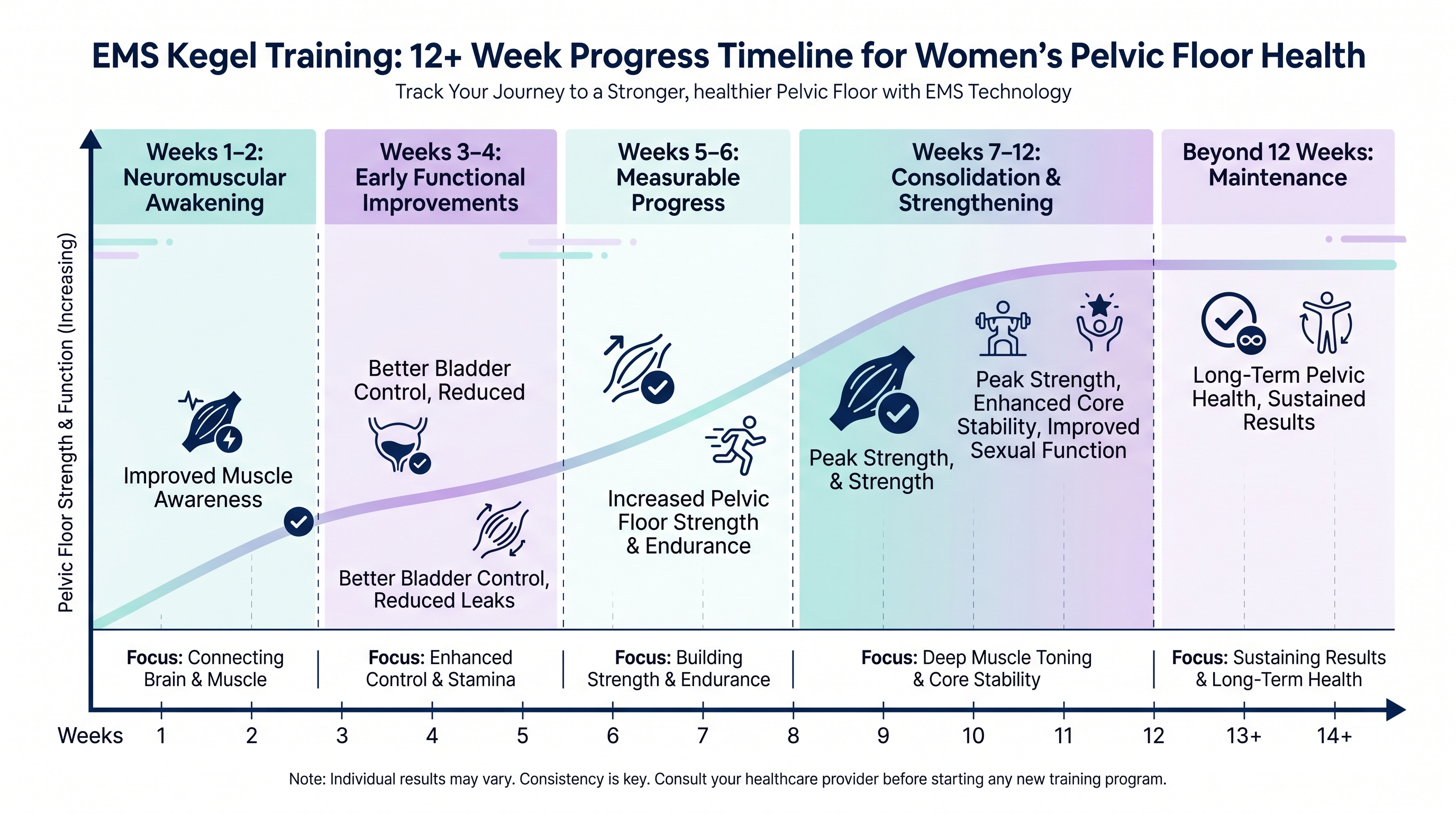
ALT: EMS Kegel training timeline chart showing week-by-week pelvic floor muscle strengthening and results progression for women
Advanced Considerations: Factors That Can Accelerate or Delay Your Results
Individual Variables That Shape Your Timeline
Not all pelvic floors are equal, and several individual factors meaningfully influence how quickly EMS Kegel training produces results.
Severity of baseline dysfunction is perhaps the most significant variable. A woman with mild stress incontinence following a single vaginal delivery will typically see faster results than someone with long-standing pelvic organ prolapse or severe post-surgical weakness. Managing expectations based on starting point is both clinically responsible and psychologically important.
Hormonal status also plays a meaningful role. Estrogen supports connective tissue elasticity and muscle quality throughout the pelvic floor; postmenopausal women with lower estrogen levels may find that progress is somewhat slower and that longer maintenance programs are necessary. This does not diminish the value of EMS training — it simply means the timeline may extend toward the 8-to-12-week range before peak results are reached.
Training consistency cannot be overstated. Missing sessions — particularly in the critical first four weeks — disrupts the neuromuscular patterning process and effectively resets some of the gains made. Research consistently shows that adherence is the single largest predictor of outcome in pelvic floor rehabilitation programs, regardless of whether the modality is manual exercise, biofeedback, or electrical stimulation.
Common Misconceptions About EMS Kegel Training
Misconception 1: "If I don't feel strong sensations, it's not working."
Many users assume that higher intensity equals faster results. In reality, the correct intensity is the lowest level at which you feel clear, comfortable muscle contractions. Training at excessive intensity can cause muscle fatigue, discomfort, and ultimately poor session adherence — the opposite of what you want.
Misconception 2: "I can skip days and catch up later."
Pelvic floor neuromuscular training requires consistent stimulus repetition. Doubling up sessions to compensate for missed days is less effective than simply maintaining your scheduled routine, and risks overtraining a muscle group that needs recovery time between sessions.
Misconception 3: "Once symptoms resolve, I can stop completely."
Resolution of symptoms is a milestone, not a finish line. Pelvic floor maintenance, much like core strength training, requires periodic ongoing stimulus to prevent regression — particularly as hormonal changes continue across the lifespan.
Frequently Asked Questions
Q1: How many EMS Kegel sessions per week are needed to see results?
Most clinical protocols recommend 3 to 5 sessions per week during the initial intensive phase of EMS Kegel training, with each session lasting approximately 15–20 minutes. Consistent spacing between sessions — rather than clustering multiple sessions in a single day — allows for adequate muscle recovery and optimal neuromuscular adaptation. After the initial 6-to-8 week intensive phase, many users successfully maintain gains with 2 to 3 sessions per week on an ongoing basis. Always follow the specific guidance provided with your device or by your healthcare provider.
Q2: Is EMS Kegel stimulation safe to use alongside other pelvic floor therapies?
For most users, EMS Kegel training is safe and complementary to other pelvic floor rehabilitation approaches, including voluntary Kegel exercises, pelvic physiotherapy, and biofeedback. In fact, combining EMS stimulation with active voluntary contractions — once you've developed baseline awareness — can accelerate strengthening beyond what either approach achieves independently. However, always inform your pelvic health physiotherapist or physician that you are using a home stimulation device so they can tailor your overall program accordingly and monitor for any contraindications specific to your medical history.
Q3: How long before EMS Kegel training results become permanent?
EMS Kegel training builds real muscle strength, meaning results can be long-lasting — but they are not unconditionally permanent. Like any muscle group, the pelvic floor requires ongoing maintenance stimulus, particularly in the context of life events such as menopause, additional pregnancies, or significant changes in physical activity level. Users who complete a full 12-week program and transition to a structured maintenance protocol typically sustain their gains most effectively. Think of it less as a temporary treatment and more as the establishment of a permanent wellness habit.
Summary
EMS Kegel training offers one of the most clinically supported, accessible, and efficient pathways to pelvic floor rehabilitation available outside a clinical setting. The key takeaways from this guide are clear:
First, most consistent users see noticeable improvement in pelvic floor strength, bladder control, and daily function within 4 to 6 weeks — with the process beginning as early as week two as neuromuscular activation takes hold.
Second, individual results vary based on baseline pelvic floor condition, hormonal status, and — most critically — training consistency. Adherence to a structured program is the single most powerful factor under your control.
Third, EMS Kegel electrical stimulation offers meaningful advantages over manual Kegel exercises alone, particularly for the significant percentage of women who cannot correctly activate their pelvic floor muscles without direct electrical guidance.
Whether you are managing postpartum recovery, navigating the pelvic health challenges of menopause, or simply investing proactively in your long-term quality of life, a professional-grade EMS Kegel device provides a drug-free, clinically informed solution that fits within your daily routine. The journey to stronger pelvic floor health begins with a single consistent session — and compounds powerfully from there.
Call to Action
Ready to take control of your pain relief and muscle health from the comfort of home? iStim offers a full range of professional-grade TENS, EMS, and Kegel devices engineered for safe, effective, drug-free therapy trusted by over 20,000 customers. Explore the complete lineup and find the right device for your needs at https://istim.com/.
References
- National Institute of Diabetes and Digestive and Kidney Diseases (NIDDK). "Kegel Exercises".
https://www.niddk.nih.gov/health-information/urologic-diseases/kegel-exercises - American College of Obstetricians and Gynecologists (ACOG). "Pelvic Support Problems".
https://www.acog.org/womens-health/faqs/pelvic-support-problems - Bø, K., et al. (2015). "Evidence-Based Physical Therapy for the Pelvic Floor: Bridging Science and Clinical Practice." Elsevier Health Sciences.
https://www.elsevier.com/books/evidence-based-physical-therapy-for-the-pelvic-floor/bo/978-0-7020-4443-4 - Cochrane Database of Systematic Reviews. "Electrical Stimulation with Non-implanted Electrodes for Urinary Incontinence in Adults".
https://www.cochranelibrary.com/cdsr/doi/10.1002/14651858.CD001202.pub3/full - National Association For Continence (NAFC). "Pelvic Floor Exercises".
https://www.nafc.org/pelvic-floor-exercises
Note: Standards and clinical guidelines may be updated. Please check the latest official documents or consult a qualified healthcare professional for the most current recommendations.
About iStim
iStim is a Los Angeles-based electrotherapy brand specializing in professional-grade TENS, EMS, and Kegel devices designed for home use, combining ISO-certified Taiwanese manufacturing with a commitment to drug-free pain relief and muscle stimulation trusted by 20,000+ customers worldwide. Learn more at https://istim.com/.
Disclaimer: This article is provided for informational and educational purposes only and does not constitute medical advice. The content is produced in association with iStim and reflects general wellness information. Always consult a qualified healthcare professional before beginning any new therapy or treatment program. © iStim. All rights reserved.
Leave a comment