

How Many Programs Do You Really Need in a TENS Machine?

ALT: Person using a professional-grade TENS electrotherapy device at home for drug-free pain relief and muscle stimulation
How Many Programs Do You Really Need in a TENS Machine? The Honest Answer
Key Conclusion: When it comes to TENS devices, more programs don't always mean better results. Whether you're using electrotherapy devices for chronic back pain, post-surgical recovery, or muscle stimulation, the number of pre-set programs matters far less than how well those programs are matched to your specific condition, body area, and therapy goals. Understanding what programs actually do — and which ones you'll realistically use — is the smartest way to choose the right TENS machine for your needs.
Most people browsing for a TENS machine instinctively reach for the one with the most modes: 24 programs, 36 programs, sometimes even more. It feels intuitive — more options must mean more versatility and better results. But in practice, the vast majority of users end up relying on just two to four core programs, and the rest go untouched. This article unpacks why that happens, what programs are actually worth having, and how to evaluate a TENS unit based on what truly matters for your health outcomes.
Who This Article Is For
✅ Applicable Scenarios:
- Adults managing chronic pain conditions such as lower back pain, sciatica, arthritis, or fibromyalgia who want to understand TENS program options
- Athletes and active individuals using electrotherapy devices for muscle recovery, post-workout soreness, or injury rehabilitation
- Post-surgery or post-injury patients transitioning from clinical physiotherapy to at-home electrotherapy and looking for a reliable, easy-to-use TENS unit
- Women exploring pelvic floor rehabilitation or general pain management with a drug-free approach
❌ Not Applicable/Cautions:
- Individuals with implanted electrical devices (such as pacemakers or spinal cord stimulators), as TENS therapy may interfere with these devices — always consult a physician first
- Those seeking a substitute for a formal medical diagnosis or treatment plan — TENS is a complementary therapy and does not replace professional medical care
- People with epilepsy, active cancer, open wounds at electrode placement sites, or during pregnancy (unless specifically directed by a healthcare provider)
The Problem With "More Programs" Marketing
Walk into any online marketplace or medical supply store and you'll find TENS machines marketed largely on program count. A unit with 20 programs is presented as superior to one with 10. A 36-program device feels like a professional-grade upgrade over a basic 6-program model. This logic is appealing — it mirrors how we think about software features or car specs. More must equal better.
But here's what clinical experience and user data consistently show: program count is one of the least predictive indicators of a TENS device's therapeutic value. What actually determines whether a TENS unit works for you includes pulse width, pulse rate (frequency), waveform type, intensity range, channel configuration, and — critically — whether the programs available are designed for your specific condition.
The at-home electrotherapy market has grown significantly in recent years, driven by rising interest in non-pharmaceutical pain management and a broader cultural shift toward taking health into one's own hands. As more consumers explore the benefits of TENS therapy, it's increasingly important to cut through marketing noise and focus on what clinical evidence actually supports. For a thorough look at how TENS stacks up against medication-based approaches, the iStim resource on TENS vs. Prescription Pain Medication: A Non-Invasive Alternative Explained is an excellent starting point.
Understanding the underlying science is equally important. The Science Behind Endorphin Release During TENS Therapy explains how electrical stimulation triggers your body's own pain-relief chemistry — a mechanism that works regardless of whether your device has 6 programs or 36.
What TENS Programs Actually Control — And How Many You'll Really Use
Three Steps to Evaluating TENS Programs Before You Buy
Step 1: Identify Your Primary Use Case
Before comparing program counts, write down your top one or two therapy goals. Are you managing chronic lower back pain? Recovering from a knee injury? Using muscle stimulation for athletic performance? Most conditions respond best to a narrow band of frequencies and pulse widths. Knowing your use case immediately tells you whether a device's programs are relevant to you — not just numerous. This step takes about five minutes and can save you from buying a device loaded with modes you'll never touch.
Step 2: Research the Core Program Types You Need
Once you know your goal, research which program types are clinically associated with that goal. Conventional TENS (high frequency, low intensity) is commonly used for acute pain. Acupuncture-like TENS (low frequency, higher intensity) is often used for deeper muscle aches and chronic conditions. Burst mode TENS delivers pulses in bursts and is used when standard modes plateau. If a device has these three plus an EMS-style mode for muscle stimulation, you likely have everything you need — regardless of whether the total program count is 8 or 28.
Step 3: Evaluate Intensity Range and Adjustability
Programs are only as useful as the intensity range they operate within. A well-calibrated TENS unit should allow you to fine-tune intensity to a level that produces a strong but comfortable sensation — not painful, not imperceptible. Devices that let you adjust frequency and pulse width manually (not just through pre-set programs) give you significantly more therapeutic flexibility. When assessing any device, look for this manual adjustability as a marker of professional-grade design.
Comparing Program Approaches: What Actually Differs Between TENS Units
Different TENS machines take different approaches to program design. Understanding these approaches helps you choose wisely rather than defaulting to whichever device has the highest program count.
| Comparison Dimension | Basic Pre-Set Units | Adjustable Parameter Units | Combo TENS/EMS Units |
|---|---|---|---|
| Program Count | Often high (20–36+) | Moderate (6–15) | Moderate to high (varies by model) |
| User Control Over Parameters | Limited — pre-set only | High — frequency, pulse width adjustable | High — separate TENS and EMS modes |
| Best For | Beginners seeking simplicity | Intermediate to advanced users with specific conditions | Athletes, recovery patients needing both pain relief and muscle stimulation |
| Clinical Versatility | Lower (limited customization) | Higher (adaptable to changing needs) | Highest (addresses both nerve and muscle pathways) |
| Learning Curve | Low | Moderate | Moderate |
| Ideal Therapy Goals | General soreness, occasional pain | Chronic conditions, targeted rehabilitation | Recovery, performance, complex pain management |
For users who need both TENS and EMS capabilities — addressing both pain pathways and muscle stimulation needs — a combination device offers the best real-world value. Understanding when to switch between modes is crucial; the guide on TENS + EMS Combo Machines Explained: When to Use Each Mode breaks this down clearly.
The Programs That Actually Matter: A Deeper Look
Conventional TENS — The Foundation Program
Conventional TENS operates at higher frequencies and lower intensities, creating a continuous tingling or buzzing sensation that works through the gate control theory of pain. It's the most commonly used mode and the one most people default to for everyday aches and pains. If a TENS unit does only one thing well, it should be this. For chronic back pain sufferers asking whether home TENS devices can match the results of physical therapy equipment, the honest answer is: for mild to moderate chronic pain management, a well-designed home TENS unit using conventional mode can deliver meaningful, consistent relief — particularly when used regularly and correctly.
Acupuncture-Like (AL-TENS) — For Deeper Chronic Pain
AL-TENS uses lower frequencies and higher intensities to produce visible muscle twitching. It stimulates deeper nerve fibers and triggers greater endorphin release, making it particularly valuable for conditions like sciatica, deep muscle tension, and chronic lower back pain. This is a program type worth specifically looking for — not just a number on a list.
Burst Mode — When Standard Programs Plateau
Burst mode delivers pulses in short, rhythmic bursts rather than continuously. Many users with chronic conditions find that their body adapts to conventional or AL-TENS over time, reducing effectiveness. Burst mode provides a different stimulation pattern that can re-engage the therapeutic response. It's a genuinely useful program, not just a marketing addition.
EMS / Muscle Stimulation Mode — Beyond Pain Relief
When your TENS device includes an EMS mode, it crosses from pure pain management into active muscle rehabilitation. Electrical muscle stimulation (EMS) works by directly triggering muscle contractions — helping prevent atrophy during recovery, improving muscle strength, and enhancing circulation. Athletes have long used EMS as part of professional training protocols. If you're interested in how sports professionals leverage this technology, the detailed breakdown in EMS for Athletes: How Professional Sports Teams Use Electrical Muscle Stimulation offers compelling context.
Massage Modes — Comfort, Not Clinical Necessity
Many TENS units include "massage" modes that simulate kneading, tapping, or cupping sensations. These are pleasant and may aid relaxation, but they are not clinically essential. If your device has them, enjoy the comfort benefit — but don't let a high count of massage-style programs inflate your perception of a device's therapeutic value.
What About Kegel / Pelvic Floor Programs?
For women focused on pelvic floor rehabilitation, standard TENS programs are not designed for internal use. Dedicated Kegel electrotherapy devices use specific frequency and intensity profiles calibrated for pelvic muscle rehabilitation. If pelvic floor health is your goal, this is an entirely separate category of electrotherapy device with its own program requirements. Understanding the signs of a weak pelvic floor is the right first step before selecting a device for this purpose.
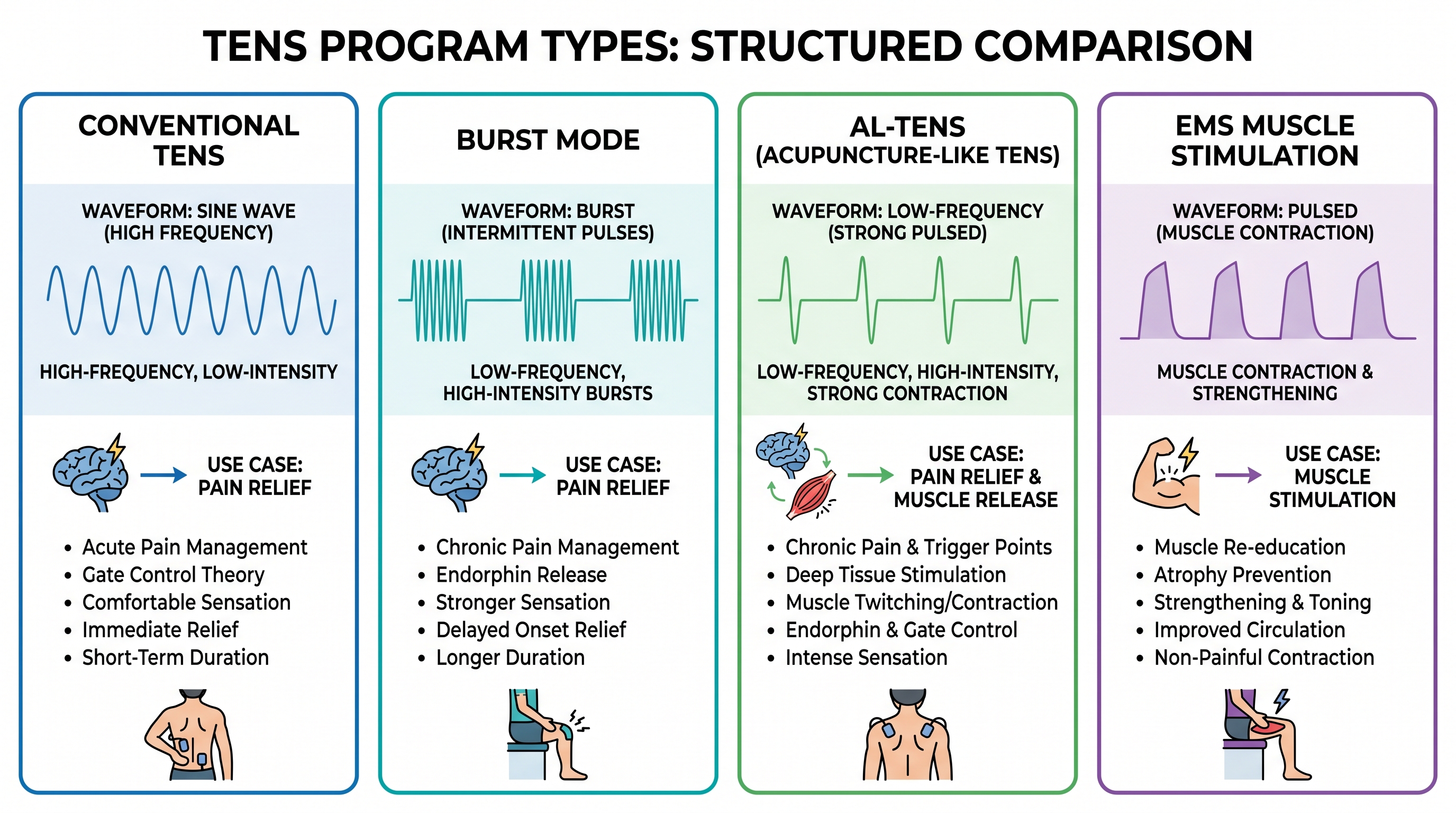
ALT: Diagram illustrating TENS program types — conventional, burst mode, AL-TENS, and EMS muscle stimulation — for at-home electrotherapy pain relief
Advanced Considerations: When Program Count Does Matter
Multi-Channel Devices and Simultaneous Treatment
If you're managing pain or muscle recovery across multiple body areas simultaneously, program count becomes more relevant because you need programs that can operate independently across different channels. A four-channel device treating your lower back, hip, knee, and shoulder at the same time may benefit from a larger program library — not because more programs are inherently better, but because you need appropriate programs for four distinct anatomical regions. For anyone managing widespread pain or full-body recovery, understanding how multi-channel systems work adds significant value to your device selection.
Common Misconception: "Higher Program Count = Professional Grade"
This is perhaps the most persistent misconception in the consumer TENS market. Professional-grade electrotherapy devices are distinguished by their precision, build quality, certifications (such as ISO manufacturing standards), intensity range accuracy, waveform quality, and safety features — not by the number of pre-set programs in their menu. A device manufactured to ISO-certified standards with eight well-calibrated programs will consistently outperform a poorly built device with thirty generic programs. When evaluating any electrotherapy device, look for manufacturing transparency, certifications, and clinical evidence — not program count.
When to Reconsider Your Current Programs
If you've been using a TENS device for several weeks and are noticing diminishing returns, the issue is rarely that you need more programs. More commonly, it's one of these factors: electrode placement has become imprecise, intensity has not been adjusted as your body adapts, the treatment session duration is too short or too long, or the program type is no longer optimal for your condition's current stage. Experimenting with the programs you already have — adjusting frequency, pulse width, and intensity — is almost always more productive than buying a device with more modes. A detailed reference on how TENS units stimulate nerve fibers to block pain signals to the brain can help you understand why these adjustments matter.
Frequently Asked Questions FAQ
Q1: How many programs should I look for in a TENS machine for chronic back pain?
For chronic back pain management, three to five core program types will cover the vast majority of your needs: conventional TENS for daily maintenance, AL-TENS for deeper pain episodes, burst mode for days when standard settings feel less effective, and an EMS mode if muscle rehabilitation is also a goal. Beyond these, additional programs offer diminishing returns. Focus instead on finding a device with a wide intensity range and accurate pulse width control — these parameters have far more impact on your relief than a high program count alone.
Q2: Is a TENS machine with more programs always more effective for muscle stimulation?
No — muscle stimulation effectiveness depends on the quality of EMS parameters (waveform accuracy, intensity range, pulse width calibration), not on how many programs a device lists. A well-engineered TENS/EMS device with a focused set of clinically calibrated programs will consistently outperform a device with numerous generic modes. When evaluating devices for muscle stimulation, look for ISO-certified manufacturing, adjustable parameters, and clear documentation of EMS-specific settings rather than defaulting to the highest program count available.
Q3: How long does it take to see results from TENS therapy, and does the program type affect the timeline?
Most users begin noticing meaningful pain relief within the first few sessions, though consistent daily use over two to four weeks tends to produce the most sustained results. Program type does influence the timeline: conventional TENS often provides faster initial relief, while AL-TENS and burst mode may take slightly longer to show their full benefit as endorphin pathways build up their response. Consistency, correct electrode placement, and appropriate intensity levels matter more than any single program selection in determining how quickly you experience results.
Summary
Choosing a TENS machine based on program count is like choosing a kitchen knife based on how many decorative engravings it has — it tells you almost nothing about performance. What truly determines whether an electrotherapy device delivers meaningful results comes down to three core factors:
- Program quality over quantity: The right programs — conventional TENS, AL-TENS, burst mode, and EMS if needed — cover virtually every therapeutic scenario for pain relief and muscle stimulation. Most users thrive with four to six well-designed programs rather than twenty generic ones.
- Adjustability and precision: Devices that allow manual control over frequency, pulse width, and intensity give you the flexibility to adapt therapy as your condition evolves — far more valuable than a large pre-set library with no room for customization.
- Manufacturing and certification standards: ISO-certified, professionally engineered devices deliver consistent, safe waveforms that actually match their specifications — the foundation of reliable at-home electrotherapy that you can trust session after session.
Before your next purchase, step back from the feature comparison tables and ask yourself: what are my actual therapy goals, and which programs are clinically matched to those goals? That question will consistently lead you to a better choice than counting pre-set modes.
Ready to take control of your pain relief and muscle recovery — naturally and drug-free? Explore iStim's full range of professional-grade TENS, EMS, and Kegel devices at https://istim.com/ and find the right solution tailored to your wellness needs. Join over 20,000 satisfied customers who have made iStim their trusted partner in at-home electrotherapy.
References
- National Institutes of Health — National Center for Complementary and Integrative Health. "Chronic Pain: What You Need To Know."
https://www.nccih.nih.gov/health/chronic-pain-what-you-need-to-know - American Physical Therapy Association. "Physical Therapist's Guide to Pain Management with Electrotherapy."
https://www.apta.org/ - U.S. Food and Drug Administration (FDA). "TENS (Transcutaneous Electrical Nerve Stimulation) Devices."
https://www.fda.gov/medical-devices/home-use-devices/transcutaneous-electrical-nerve-stimulators-tens - Mayo Clinic. "TENS (Transcutaneous Electrical Nerve Stimulation): What You Need to Know."
https://www.mayoclinic.org/tests-procedures/tens/about/pac-20393608 - Cochrane Library. "Transcutaneous Electrical Nerve Stimulation (TENS) for Chronic Pain — An Overview of Cochrane Reviews."
https://www.cochranelibrary.com/
Note: Standards and clinical guidelines may be updated. Please check the latest official documents or consult a qualified healthcare professional for the most current recommendations.
About iStim
iStim is a Los Angeles-based electrotherapy brand specializing in professional-grade TENS, EMS, and Kegel devices engineered for safe, effective home use — backed by ISO-certified Taiwanese manufacturing and trusted by 20,000+ Amazon customers for drug-free pain relief and muscle stimulation. Learn more at istim.com.
© iStim. All rights reserved. This article is intended for informational purposes only and does not constitute medical advice. Always consult a qualified healthcare professional before beginning any electrotherapy or treatment program.
About iStim
iStim is a Los Angeles-based electrotherapy brand specializing in professional-grade TENS, EMS, and Kegel devices engineered for safe, effective home use — backed by ISO-certified Taiwanese manufacturing and trusted by 20,000+ Amazon customers for drug-free pain relief and muscle stimulation. Learn more at istim.com.
© iStim. All rights reserved. This article is intended for informational purposes only and does not constitute medical advice. Always consult a qualified healthcare professional before beginning any electrotherapy or treatment program.
Leave a comment