

EMS vs. Manual Kegel Exercises: Which Is More Effective for Bladder Control?

ALT: Woman practicing pelvic floor exercises comparing EMS Kegel device and manual Kegel training for bladder control
EMS vs. Manual Kegel Exercises: Which Method Really Improves Bladder Control?
Key Conclusion: Both EMS Kegel therapy and manual Kegel exercises can meaningfully improve bladder control and pelvic floor strength, but they work through different mechanisms and suit different users. EMS delivers precisely timed electrical impulses that recruit deep pelvic floor muscles automatically — making it especially valuable for individuals who struggle to correctly identify or contract the right muscles. Manual Kegels, when performed correctly and consistently, remain a proven, evidence-backed first-line approach for mild to moderate symptoms.
Millions of adults quietly deal with urinary leakage, urgency, and reduced bladder control — conditions collectively linked to a weakened pelvic floor. Whether you're a postpartum mother returning to exercise, a woman navigating hormonal changes after 40, or a man recovering from prostate surgery, the question of which pelvic floor training approach is most effective is both personal and urgent.
In this article, we'll break down the real differences between EMS (Electrical Muscle Stimulation) for the pelvic floor and traditional manual Kegel exercises — covering how each works, who benefits most, how quickly you might see results, and how combining both could accelerate your progress. By the end, you'll have a clear, evidence-informed roadmap for choosing the approach — or combination — that's right for your situation.
Who Should Read This: Applicable Scenarios and Cautions
✅ Applicable Scenarios:
- Adults experiencing stress urinary incontinence (leakage during coughing, sneezing, or exercise)
- Postpartum women looking to rebuild pelvic floor strength after vaginal delivery
- Women over 40 noticing weakening bladder control related to perimenopause or menopause
- Men recovering from prostate procedures who experience urinary leakage
- Individuals who have tried manual Kegels without noticeable improvement
- Anyone who has difficulty identifying or isolating the correct pelvic floor muscles
❌ Not Applicable/Cautions:
- Individuals with implanted electronic devices (e.g., pacemakers) — EMS/electrical stimulation devices are contraindicated
- Pregnant women — should consult a healthcare provider before using any form of pelvic floor electrical stimulation
- Those with active pelvic infections, open wounds, or skin irritations in the treatment area
- People experiencing urge incontinence primarily due to neurological conditions — professional clinical evaluation is recommended first
Understanding the Pelvic Floor Problem: Why So Many People Struggle
The pelvic floor is a group of muscles and connective tissues that span the base of the pelvis, supporting the bladder, bowel, and — in women — the uterus. When these muscles become weakened or uncoordinated, the result can range from mild occasional leakage to significant disruption of daily life.
According to the National Institutes of Health (NIH), urinary incontinence affects an estimated one-third of women in the United States at some point in their lives, with prevalence increasing sharply after childbirth and menopause. Men are not exempt: post-prostatectomy urinary leakage is one of the most commonly reported quality-of-life concerns following prostate surgery.
What makes the pelvic floor uniquely challenging to train is that these muscles are largely invisible — you can't see them working the way you can watch your bicep flex. Many people who try manual Kegel exercises report limited success not because the exercises don't work, but because they were never quite sure they were contracting the right muscles in the first place. Studies suggest that nearly 30% of women given verbal instructions alone for Kegel exercises perform them incorrectly — often bearing down rather than lifting up, which can worsen symptoms over time.
This is precisely where technology-assisted options like pelvic floor EMS devices have entered the conversation. If you're curious about how muscle stimulation technology works more broadly, the article How EMS Helps Muscles Contract, Recover, and Grow Stronger offers an excellent scientific foundation. Additionally, if you're exploring the broader landscape of non-pharmaceutical therapies, EMS for Athletes: How Professional Sports Teams Use Electrical Muscle Stimulation demonstrates just how far electrical stimulation has come as a clinical and performance tool.
Understanding pelvic floor dysfunction as a genuine health issue — not just an inconvenience — is the first step toward choosing a solution that actually works.
The Core Comparison: EMS Kegel Therapy vs. Manual Kegel Exercises
Getting Started: A Three-Step Approach to Pelvic Floor Training
Step 1: Identify Your Baseline and Goals
Before choosing between EMS and manual training, take stock of your current situation. Are you noticing leakage with physical exertion (stress incontinence), sudden urges you can't suppress (urge incontinence), or general weakness and discomfort? If you're unsure which muscles to contract during a Kegel, or if you've practiced manual Kegels for several weeks without improvement, these are strong signals that EMS-assisted training may offer a meaningful advantage. Allow yourself one to two minutes to honestly assess your symptoms.
Step 2: Choose Your Primary Training Method (or Combination)
If you can confidently isolate and contract your pelvic floor muscles and your symptoms are mild, beginning with a consistent manual Kegel program is a reasonable first step — aiming for three sets of 10 contractions daily. If you have difficulty isolating the muscles, have tried Kegels before without success, or want to accelerate your results with a device, an EMS Kegel trainer can guide your muscles automatically. Many practitioners recommend combining both: using EMS to establish neuromuscular awareness, then reinforcing with manual Kegels independently.
Step 3: Track Your Progress Over a Consistent Timeline
Pelvic floor improvement is measured in weeks and months, not days. Commit to a regular schedule — whether device-assisted or manual — and track specific metrics like the frequency of leakage episodes, urgency sensations, or how many contractions you can hold before fatigue. Most clinical studies on pelvic floor training report measurable improvements after six to twelve weeks of consistent practice. Revisit your symptoms at that milestone and adjust your approach based on what you observe.
Side-by-Side Comparison: EMS Kegel Devices vs. Manual Kegel Exercises
Understanding the practical differences between these two approaches helps you make a more confident, informed decision. The table below compares the most clinically and practically relevant dimensions:
| Comparison Dimension | EMS Kegel Device | Manual Kegel Exercises | Combination Approach |
|---|---|---|---|
| Muscle Targeting Accuracy | High — electrical impulse directly recruits pelvic floor muscles | Variable — depends on user's ability to isolate correct muscles | High — EMS establishes awareness, manual reinforces it |
| Ease of Correct Execution | High — device guides contractions automatically | Moderate to Low — up to 30% of users perform incorrectly without guidance | High — EMS corrects form before manual practice begins |
| Speed of Initial Results | Faster for those with poor muscle awareness | Slower if technique is incorrect; faster if technique is sound | Fastest overall for most users |
| Convenience | Requires device, setup time, and cleaning | No equipment needed, can be done anywhere, anytime | Requires device but maximizes flexibility |
| Cost | One-time device investment | Free | One-time device investment |
| Suitability for Severe Weakness | Excellent — works even with very weak baseline | Limited — requires some baseline voluntary contraction ability | Excellent |
| Long-Term Sustainability | Good — used as needed or as part of routine | Excellent — no barriers once technique is learned | Excellent — device phases out as skill improves |
| Clinical Evidence Level | Strong — supported by multiple RCTs for stress/urge incontinence | Strong — established first-line recommendation by most guidelines | Strong — combination often outperforms either alone |
How EMS Kegel Devices Work — and Why They Can Outperform Manual Training Alone
The Science of Electrical Pelvic Floor Stimulation
EMS (Electrical Muscle Stimulation) works by delivering low-level electrical impulses through a probe or external electrodes placed near the pelvic floor. These impulses mimic the signals your nervous system sends to contract muscles — but they do so automatically, without requiring you to consciously initiate the contraction. This is a critical distinction for pelvic floor training, because many people with weakened pelvic muscles have also lost some degree of neuromuscular connection — the brain-muscle communication pathway that allows voluntary contraction.
When a Kegel EMS device sends its signal, the pelvic floor muscles are recruited directly and completely, including deep muscle fibers that many people never manage to activate voluntarily. This makes EMS particularly effective in cases of significant muscle weakness, postpartum recovery, or post-surgical rehabilitation where voluntary contraction is limited or unreliable.
For those interested in the intersection of EMS and broader health applications, it's worth noting that research has explored Signs of a Weak Pelvic Floor: How to Recognize the Symptoms in detail — identifying early warning signs is essential to knowing when intervention is needed.
The iStim V2 Kegel Exerciser: Professional-Grade EMS at Home
iStim's approach to Kegel training centers on making professional-quality electrical pelvic floor stimulation accessible at home. The How to Use the iStim V2 Kegel Exerciser: A Complete Setup and Usage Guide walks users through setup, positioning, and program selection — an invaluable resource for anyone new to device-assisted pelvic floor training.
The iStim V2 Kegel Exerciser is designed to deliver consistent, adjustable electrical stimulation that helps users identify and strengthen their pelvic floor without guesswork. Because it's built to professional-grade specifications backed by ISO-certified manufacturing, users can trust the device is delivering safe, calibrated output — not an arbitrary shock level. The adjustable intensity settings allow gradual progression, making it suitable for complete beginners as well as those resuming training after a gap.
What Manual Kegel Exercises Do Well
Manual Kegel exercises have decades of clinical research behind them and remain the first-line recommendation from most urogynecology and physiotherapy guidelines for stress and mixed urinary incontinence. They're free, completely private, and can be performed anywhere — sitting at a desk, lying in bed, or standing in line at the grocery store.
The key to manual Kegel success is technique and consistency. A correct Kegel involves lifting and squeezing the muscles you'd use to stop the flow of urine — without holding your breath, tightening your thighs, or contracting your abdomen. Holding each contraction for several seconds before releasing, and completing multiple sets daily, progressively strengthens the pelvic floor over time.
For mild stress incontinence with good baseline muscle awareness, a well-executed manual Kegel program can produce significant improvement within six to twelve weeks. The challenge is that consistency and correct technique are both harder to maintain than they sound — and without feedback, users often can't tell whether they're doing it right.
The Overlooked Dimension: Pelvic Floor EMS and Male Health
While pelvic floor training is often discussed in the context of women's health, men dealing with post-prostatectomy incontinence or erectile dysfunction can also benefit significantly. Electrical stimulation of the pelvic floor helps men rebuild the muscular support structures that control urinary sphincter function and pelvic blood flow. Some research has explored the use of pelvic floor stimulators for erectile dysfunction, with findings suggesting that targeted EMS may improve both continence and erectile function by strengthening the bulbocavernosus and ischiocavernosus muscles — the pelvic floor muscles most associated with erectile response. While the research is still developing, the potential benefits for men represent an important and underappreciated application of EMS Kegel technology.
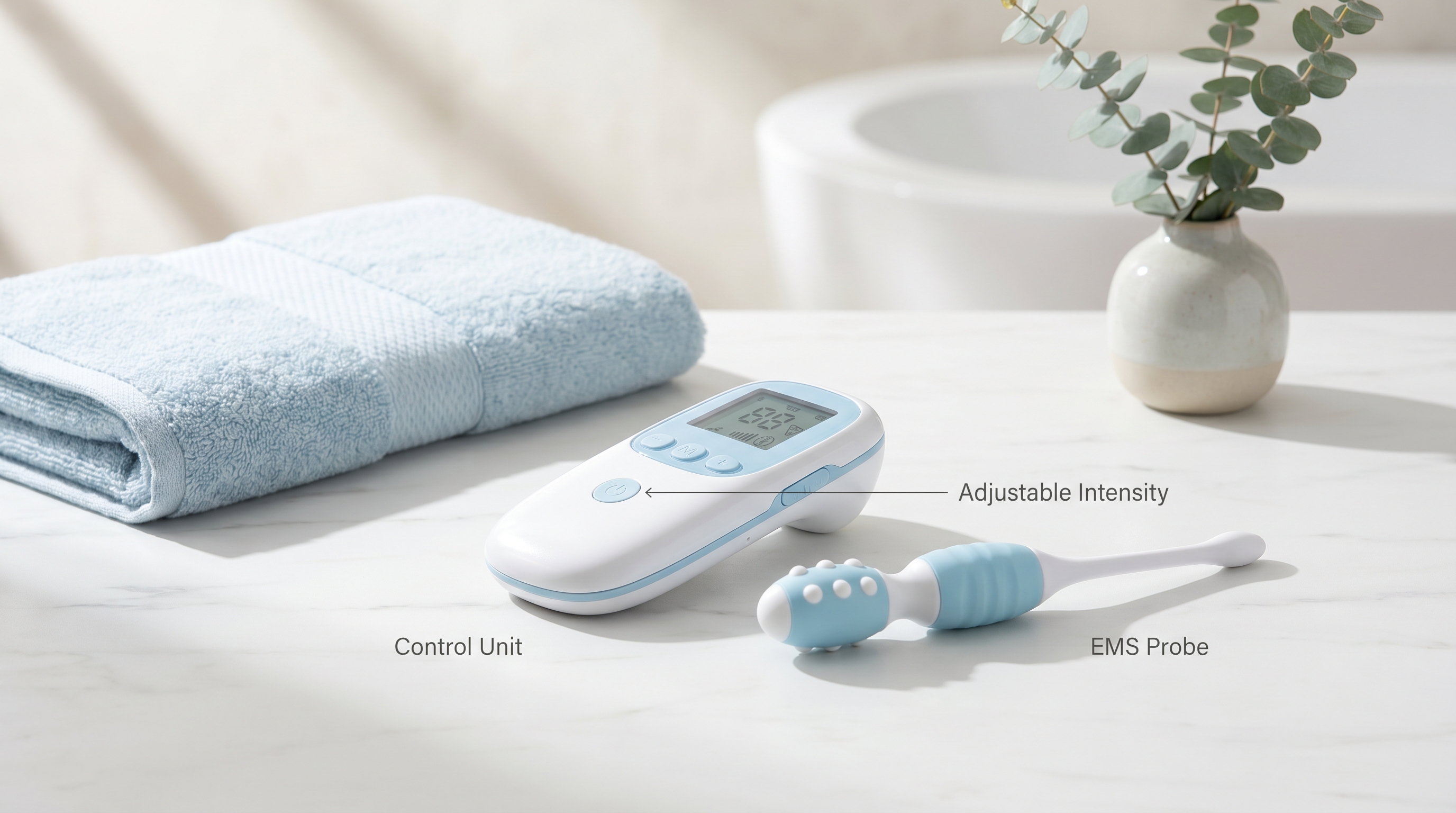
ALT: iStim V2 Kegel EMS Kegel exerciser device for pelvic floor training and improved bladder control used at home
Advanced Considerations: Combining Methods, Common Misconceptions, and Safety
Getting Faster Results: Is Combining EMS and Manual Training Better?
The short answer is yes — for most users, a combination approach produces the best results faster than either method alone. Here's why: EMS establishes the neuromuscular pathway by forcing correct muscle recruitment, which teaches your brain and body what a proper pelvic floor contraction actually feels like. Once that awareness is established, manual Kegel exercises reinforce and deepen the training — and eventually, users can transition to primarily manual practice with device sessions as periodic reinforcement.
Think of EMS as a personal trainer who physically guides your hand through the correct motion, and manual Kegels as independent practice afterward. The guided session accelerates learning; the independent practice builds lasting strength. Urinary Incontinence After Childbirth: Causes, Impact, and Treatment Options discusses this combined approach in the postpartum context, where rebuilding pelvic floor function quickly and correctly is especially important.
Common Misconceptions About Kegel Training
Misconception 1: "Kegels are only for women." Pelvic floor muscles exist in both sexes and serve essential functions in men — including urinary control, sexual function, and pelvic stability. EMS Kegel devices and manual exercises benefit men, particularly after prostate surgery.
Misconception 2: "More is always better with Kegels." Overtrained pelvic floor muscles can become hypertonic (too tight), which can actually worsen bladder urgency and cause pelvic pain. Balance and progressive loading matter just as much as frequency.
Misconception 3: "If I don't feel anything happening, the EMS device isn't working." Pelvic floor stimulation at therapeutic intensities is often subtle. The goal is not sharp discomfort — it's a gentle contraction. Gradually increasing intensity as tolerated is the correct approach.
Safety Precautions When Using EMS Kegel Devices
Following basic safety precautions when using EMS devices ensures a positive experience. Always start at the lowest intensity setting and increase gradually. Keep the device and probe clean according to manufacturer instructions. Do not use the device if you have a pacemaker or implanted stimulator, during pregnancy without medical clearance, or over areas of active skin irritation. If you experience unusual pain, burning, or worsening symptoms, discontinue use and consult a healthcare provider.
Frequently Asked Questions FAQ
Q1: How long does it take to see results from EMS Kegel training compared to manual exercises?
Most users report noticing early improvements in bladder control — fewer leakage episodes or reduced urgency — within four to eight weeks of consistent use with an EMS Kegel device, particularly when sessions are conducted several times per week. Manual Kegel exercises performed correctly also show measurable results within six to twelve weeks according to clinical studies, though outcomes depend heavily on technique quality. Combining both methods often accelerates progress. As with all pelvic floor training, consistency over time matters more than intensity in any single session.
Q2: Is an EMS Kegel device safe to use at home without a prescription?
For most healthy adults, FDA-cleared or professionally manufactured EMS Kegel devices designed for home use are safe when used as directed. iStim's devices are produced under ISO-certified manufacturing standards, ensuring consistent, calibrated output. However, anyone with a pacemaker, implanted defibrillator, active pelvic infection, or who is pregnant should consult a healthcare provider before using any electrical stimulation device. If you have been diagnosed with a neurological condition affecting bladder function, a clinical evaluation before beginning device-assisted training is strongly recommended.
Q3: How often should I use an EMS Kegel device for best results, and is there a risk of overtraining?
Most clinical protocols for EMS-assisted pelvic floor training recommend sessions of fifteen to thirty minutes, three to five times per week, with at least one rest day between sessions to allow for muscle recovery. Overtraining the pelvic floor — whether with EMS or manual Kegels — can lead to hypertonic muscles, increased urgency, or pelvic discomfort. The key is progressive loading: begin conservatively, monitor your symptoms, and increase frequency or duration only when you're tolerating current sessions comfortably without post-session soreness or increased urgency.
Summary
Bladder control is something millions of people quietly struggle with — and both EMS Kegel therapy and manual Kegel exercises offer genuine, evidence-supported pathways to improvement. The most important takeaways from this comparison are:
- Manual Kegels work — but only when done correctly and consistently. Up to 30% of users perform them incorrectly without feedback, which limits their effectiveness. If you've tried Kegels before without success, technique may be the barrier, not your body.
- EMS Kegel devices remove the guesswork. By directly stimulating pelvic floor muscles, they ensure complete and accurate muscle recruitment — making them especially valuable for beginners, postpartum women, older adults, and men rebuilding after prostate surgery.
- Combining both approaches produces the fastest, most durable results. Use EMS to establish correct neuromuscular patterns, then reinforce them with independent manual practice as your awareness and strength improve.
The right approach depends on your specific symptoms, baseline muscle awareness, and lifestyle — but whichever path you choose, consistency is the most powerful variable in your success.
Ready to Strengthen Your Pelvic Floor With Professional-Grade EMS Technology?
Ready to take control of your pain relief and muscle health from the comfort of home? iStim offers a full range of professional-grade TENS, EMS, and Kegel devices designed to deliver real, drug-free results — trusted by over 20,000 satisfied customers. Explore the complete lineup and find the right device for your needs at https://istim.com/.
References
- National Institute of Diabetes and Digestive and Kidney Diseases (NIDDK). "Kegel Exercises".
https://www.niddk.nih.gov/health-information/urologic-diseases/kegel-exercises - National Association for Continence (NAFC). "Pelvic Floor Muscle Training (Kegel Exercises)".
https://www.nafc.org/kegel-exercises - Dumoulin, C., Cacciari, L.P., & Hay-Smith, E.J.C. (Cochrane Database). "Pelvic Floor Muscle Training Versus No Treatment, or Inactive Control Treatments, for Urinary Incontinence in Women".
https://www.cochranelibrary.com/cdsr/doi/10.1002/14651858.CD005654.pub4/full - National Institutes of Health (NIH), Office of Research on Women's Health. "Urinary Incontinence".
https://orwh.od.nih.gov/research/supported-research/urinary-incontinence - American Urological Association (AUA). "Nonsurgical Treatments for Urinary Incontinence in Adult Women: A Clinical Practice Guideline".
https://www.auanet.org/guidelines-and-quality/guidelines/non-surgical-management-of-urinary-incontinence
Note: Standards may be updated; please check the latest official documents or consult professional advisors.
About iStim
iStim is a Los Angeles-based electrotherapy brand specializing in professional-grade TENS, EMS, and Kegel devices for home use, backed by ISO-certified Taiwanese manufacturing and trusted by 20,000+ customers for safe, drug-free pain relief and muscle stimulation. Learn more at istim.com.
Disclaimer: This article is produced by the iStim content team and is intended for informational purposes only. It does not constitute medical advice, diagnosis, or treatment. Always consult a qualified healthcare professional before starting any new therapy or treatment program. © iStim. All rights reserved.
Leave a comment