

EMS for Core Strengthening: How to Add Electrical Stimulation to Your Ab Routine

ALT: Person applying EMS electrical stimulation pads to abdominal muscles for core strengthening workout
Why EMS for Core Strengthening Is Changing the Way We Train Ab Muscles
Key Conclusion: Electrical Muscle Stimulation (EMS) technology is reshaping core training by delivering targeted electrical impulses that activate deep abdominal muscles often missed by conventional exercise. While TENS devices are primarily associated with drug-free pain relief, EMS works alongside your existing ab routine to recruit more muscle fibers, accelerate neuromuscular coordination, and support faster recovery — making it a powerful, science-backed tool for athletes, rehabilitation patients, and fitness-focused individuals alike.
If you've ever struggled to "feel" your core working during planks or crunches, you're not alone. Many people have poor neuromuscular connection to deep stabilizing muscles like the transverse abdominis — and no amount of traditional exercise alone may bridge that gap quickly. EMS for core strengthening offers a solution by sending low-level electrical impulses directly into the muscle tissue, triggering involuntary contractions that supplement voluntary exercise effort. This approach has long been used by professional sports teams and physical therapists, and now, thanks to clinical-quality home devices from brands like iStim, it's accessible to everyday fitness enthusiasts and recovery patients alike.
Who Should Consider Adding EMS to Their Core Routine
✅ Applicable Scenarios:
- Athletes and fitness enthusiasts looking to enhance core activation, muscle recruitment, and workout efficiency
- Post-surgery or post-injury individuals recovering core strength under clinician supervision (e.g., post-cesarean, lower back rehabilitation)
- Adults with chronic lower back pain who want to strengthen supporting spinal muscles without high-impact strain
- Individuals with poor mind-muscle connection who struggle to activate deep core muscles during conventional training
- Busy professionals seeking time-efficient ways to supplement their existing exercise programming
❌ Not Applicable/Cautions:
- Individuals with implanted electronic devices such as pacemakers or defibrillators — electrical stimulation can interfere with device function
- People with active skin infections, open wounds, or rashes in the abdominal area where pads would be placed
- Pregnant individuals should avoid EMS over the abdominal region without explicit clearance from their healthcare provider
- Those with diagnosed epilepsy or certain heart conditions should consult a physician before beginning any electrotherapy program
- Children under 18 should only use EMS devices under direct medical supervision
The Science Behind EMS and Core Muscle Activation
The core is far more than your six-pack. It encompasses a layered system of muscles — the superficial rectus abdominis, the internal and external obliques, and most importantly, the deep transverse abdominis and multifidus — all working in concert to stabilize the spine, transfer force between upper and lower body, and protect internal organs. Traditional training methods are excellent at engaging the outer, more visible muscles. But the deep stabilizers? Those often require sophisticated cueing, years of training experience, or therapeutic intervention to truly activate.
This is where electrical muscle stimulation enters the picture. EMS technology works by delivering controlled electrical impulses through electrode pads placed on the skin's surface. These impulses mimic the signals sent by the central nervous system to trigger muscle contractions — but bypass the need for voluntary neural recruitment. The result is a direct, measurable contraction of the targeted muscle group. For core training, this means you can engage your transverse abdominis and other deep stabilizers simultaneously with your regular exercises, dramatically amplifying the training stimulus. To understand more about how this physiological process works at the fiber level, learn how EMS helps muscles contract, recover, and grow stronger through its electrical signaling mechanisms.
Interest in EMS for fitness is not a passing trend. Research published in sports science and physical therapy literature consistently demonstrates that EMS, when combined with voluntary exercise, produces superior strength and endurance gains compared to exercise alone. Elite athletes have used EMS for decades — football players, Olympic sprinters, and competitive swimmers all incorporate it into their training regimens. As detailed in the comprehensive guide on EMS for athletes and how professional sports teams use electrical muscle stimulation, this technology has migrated from elite sport to mainstream wellness — and iStim's professional-grade devices are designed to bring that same clinical standard to your home.
The growing consumer interest in non-pharmaceutical, non-invasive wellness solutions has also played a major role in EMS adoption. Health-conscious adults are increasingly seeking alternatives that work with their bodies rather than relying on medication cycles. EMS represents exactly this kind of empowered, evidence-based self-care — a fact supported by the rapid growth of the home electrotherapy market over the past several years.
How to Add EMS to Your Ab Routine: A Practical Guide
Three-Step Quick Start for EMS Core Training
Step 1: Prepare Your Skin and Place the Electrode Pads Correctly
Clean the abdominal area with mild soap and water, then dry thoroughly. Slightly damp skin improves conductivity, but excess moisture or oil can reduce pad adhesion and signal quality. For core strengthening, standard electrode placements include the upper rectus abdominis (below the sternum), lower rectus abdominis (above the pubic area), and the oblique lines running diagonally from the ribs toward the hips. Ensure pads are firmly adhered with no air bubbles. Always follow the specific placement guidance included with your iStim device, as proper placement is critical to both safety and effectiveness. This preparation phase typically takes 3–5 minutes.
Step 2: Select the Appropriate EMS Mode and Intensity
Turn on your iStim EMS device and select an EMS program designed for muscle strengthening or toning — not a TENS pain-relief mode. Begin with the lowest comfortable intensity and gradually increase until you feel a firm, rhythmic contraction in the targeted muscles. You should feel the muscle working, not pain or discomfort. iStim's professional-grade devices offer multiple program settings that align with different training goals, from gentle toning for rehabilitation contexts to more vigorous stimulation for athletic conditioning. Take 2–3 minutes to find your comfortable working intensity before beginning your paired exercise.
Step 3: Pair EMS with Complementary Ab Exercises
The most effective approach combines EMS stimulation with active, voluntary core exercises. While the device runs its stimulation cycle, perform exercises such as dead bugs, bird dogs, hollow body holds, or slow bicycle crunches. The EMS amplifies muscle activation during voluntary movement, creating a compounding training effect. A typical combined session runs 20–30 minutes, including warm-up. Finish with a 5-minute passive EMS recovery cycle at a lower intensity to promote circulation and reduce post-exercise soreness. Using EMS to boost local blood circulation and reduce muscle fatigue after training is one of the most underutilized recovery strategies available to home users.
Comparing Core Strengthening Approaches: Traditional Training vs. EMS vs. Combined Method
Not all core training strategies are equal, and understanding where EMS fits in the broader landscape helps you make informed decisions. The table below compares three major approaches based on dimensions relevant to everyday users.
| Comparison Dimension | Traditional Core Training | Standalone EMS | Combined EMS + Exercise |
|---|---|---|---|
| Deep Muscle Activation | Moderate (technique-dependent) | High (targets both superficial and deep fibers) | Very High (synergistic effect) |
| Skill/Learning Curve | Moderate to High | Low to Moderate | Moderate |
| Time Efficiency | Moderate | High | High |
| Suitability for Rehabilitation | Varies by condition | High (low impact, controlled) | High (when cleared by clinician) |
| Equipment Required | None | EMS device + pads | EMS device + pads + space |
| Pain Relief Benefit | Indirect (through strengthening) | Moderate (circulation support) | Moderate to High |
| Cost Over Time | Low | Moderate (device + replacement pads) | Moderate |
| Professional-Grade Option at Home | Not applicable | iStim EMS devices | iStim EMS devices |
The combined approach consistently emerges as the most effective strategy for both performance and rehabilitation goals — a finding echoed by physical therapists and exercise scientists worldwide.
Detailed Guide: Optimizing Your EMS Core Sessions for Maximum Results
Choosing the Right Device for Home Core Training
Not all EMS devices deliver the same quality of stimulation. Clinical and professional-grade devices use precise waveform control to ensure the electrical pulses are effective, comfortable, and consistent. iStim's EMS devices are manufactured to ISO-certified standards through Taiwanese production facilities — the same quality framework used in professional clinical equipment. This manufacturing rigor means you're receiving predictable, reliable stimulation rather than the inconsistent output that can characterize lower-quality consumer devices.
When evaluating whether a home device can replicate clinic-level results, many users ask: does a home EMS device work as well as physical therapist office equipment for muscle stimulation? The honest answer is that professional clinical EMS machines often have a wider range of settings and waveform options optimized for specific therapeutic protocols. However, high-quality home devices like those from iStim close this gap significantly — especially for general fitness, core strengthening, and complementary recovery use. For specialized post-surgical rehabilitation, always work alongside a licensed physical therapist who can tailor both the exercise and EMS parameters to your specific clinical needs.
Building a Weekly EMS Core Training Schedule
Consistency is the cornerstone of core development. A well-structured weekly schedule might look like the following:
- Days 1, 3, 5: Active EMS core sessions (20–30 minutes combined with voluntary exercise)
- Days 2, 4: Rest or passive EMS recovery at low intensity (10–15 minutes to support circulation)
- Day 6: Optional active session or full body mobility work
- Day 7: Complete rest
This schedule respects the muscle's need for recovery — remember, EMS creates real muscular contractions that require the same recovery window as voluntary exercise. Overuse can lead to fatigue or soreness, particularly in early training weeks when your neuromuscular system is adapting to the new stimulus.
The best way to combine EMS training with regular workouts is to think of EMS as a tool for both amplification and recovery — not a replacement for structured progressive training. Use it to enhance activation during strength sessions, then dial down to gentle stimulation mode for post-workout recovery. This dual-use approach maximizes the value of your device investment and supports sustainable training habits.
Electrode Placement Tips for Core-Specific Results
Effective EMS core training depends heavily on accurate electrode placement. For the rectus abdominis, place pads in a parallel vertical alignment along the muscle belly on either side of the midline. For the obliques, angle pads diagonally along the natural fiber direction of the muscle. Avoid placing pads directly over the spine, the lower back kidney area, or across the chest and heart.
If you're new to electrotherapy, it's worth taking time to understand proper placement fundamentals. The principles that apply to TENS electrode placement also inform good EMS practice — specifically regarding skin preparation, pad distance, and avoiding bony prominences or joints. For a thorough reference on electrode placement fundamentals, the concepts outlined in guides for full-body applications are directly transferable to core training contexts.
Integrating Pelvic Floor Awareness into Core EMS Sessions
The core and pelvic floor are intimately connected — the pelvic floor acts as the "base" of the core canister, and weakness in one area often manifests as dysfunction in the other. For women recovering from childbirth, experiencing pelvic floor weakness, or working through lower abdominal rehabilitation, combining core EMS with dedicated pelvic floor attention is particularly valuable. iStim also manufactures clinical-quality Kegel electrotherapy devices specifically designed to support pelvic floor strengthening — a natural companion to any comprehensive core rehabilitation program.
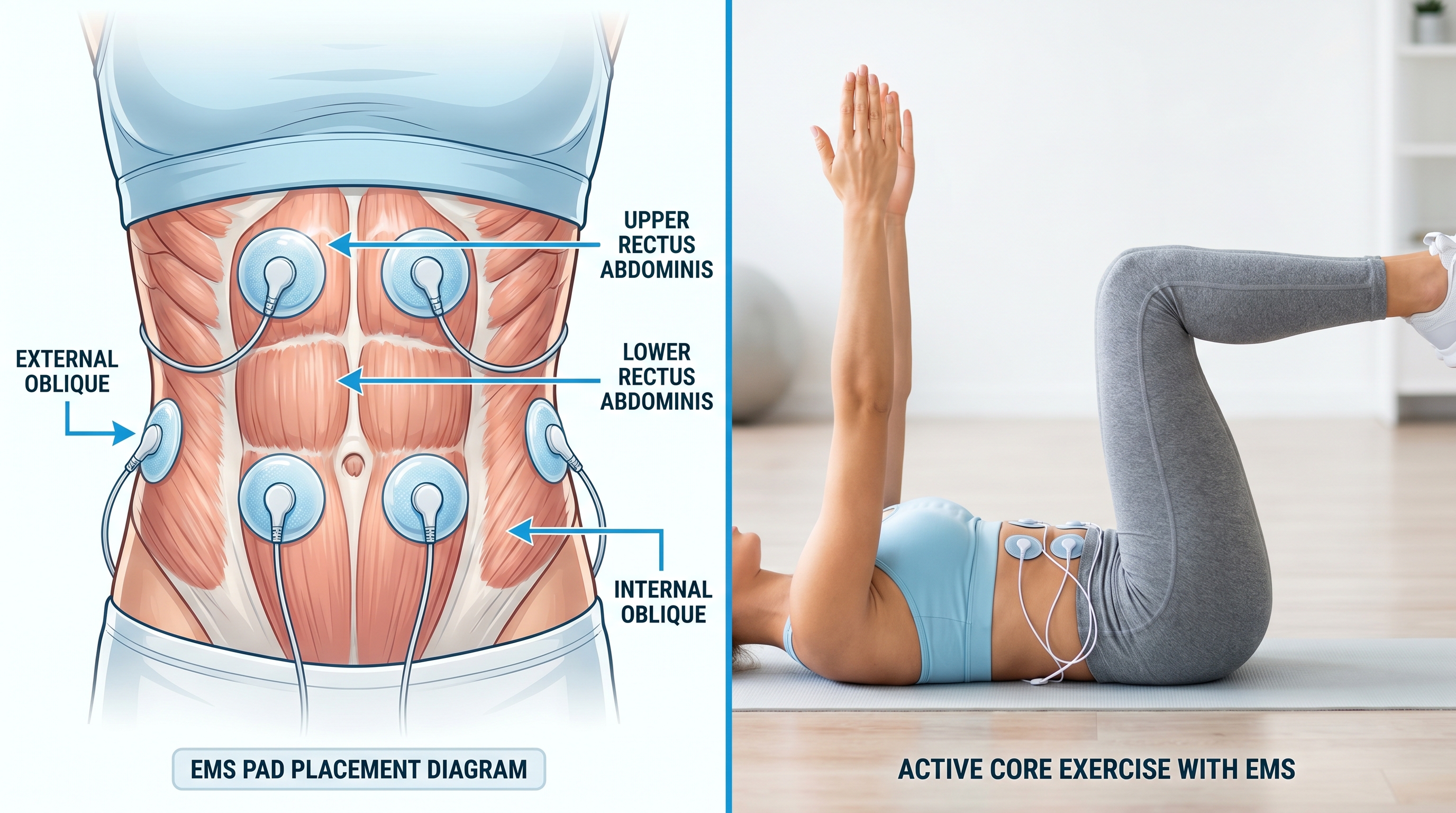
ALT: EMS electrode pad placement on abdominal muscles during core exercise for electrical muscle stimulation strengthening
Advanced Considerations: Getting More from Your EMS Core Program
Managing Progressive Overload with EMS
Just as conventional strength training requires progressive increases in load over time, EMS programs should also evolve. Begin with lower intensities and shorter session durations in weeks one and two, then gradually increase intensity and introduce more demanding paired exercises as your neuromuscular adaptation progresses. iStim devices with multiple program settings allow you to transition between modes — for example, moving from a gentle toning program to a more advanced strength-building protocol — supporting long-term progression without requiring a new device.
Common Misconceptions About EMS and Core Training
Misconception 1: EMS alone will give you visible abs.
EMS is a training and rehabilitation tool — not a cosmetic shortcut. While it significantly improves muscle activation and strength, visible abdominal definition requires an integrated approach including appropriate nutrition, overall body fat management, and consistent cardio alongside resistance training. Manage your expectations accordingly.
Misconception 2: More intensity always means better results.
Higher stimulation intensity is not inherently more effective. Overly high settings can cause discomfort, involuntary muscle guarding, or unnecessary soreness without adding proportional training benefit. The optimal intensity is the highest level at which you can feel strong, rhythmic contractions without pain — typically described as "firm but comfortable."
Misconception 3: EMS and TENS are interchangeable for core training.
They serve different primary purposes. TENS (Transcutaneous Electrical Nerve Stimulation) is primarily designed for drug-free pain relief by modulating nerve signal transmission. EMS targets muscle tissue directly to induce contractions. While some combination devices offer both modes, understanding which mode you're using — and why — is essential to achieving your intended outcome. For a complete breakdown of when to use each mode, the guide on TENS + EMS combo machines and when to use each mode is an excellent resource.
Safety and Contraindications Recap
Always review contraindications before beginning EMS core training. If you have any underlying cardiovascular condition, neurological disorder, or are recovering from abdominal surgery, obtain medical clearance from your healthcare provider before starting. EMS is a powerful tool precisely because it directly stimulates muscle tissue — which also means it must be used responsibly. iStim's ISO-certified devices include detailed safety guidelines with every product to help users make informed, safe decisions.
Frequently Asked Questions FAQ
Q1: How do I know if EMS is actually activating my deep core muscles?
During effective EMS stimulation of the core, you should feel rhythmic, involuntary contractions deep within the abdominal wall — not just surface-level twitching. If you place a hand gently on your abdomen during a session, you may feel the muscle hardening and releasing in sync with the stimulation pulses. If you're only feeling sensation at the skin surface, try adjusting pad placement or increasing intensity gradually. Working with a physical therapist initially can help you confirm you're achieving the targeted muscle activation you're aiming for.
Q2: Is it safe to use EMS on my core every day?
Daily EMS core stimulation is generally not recommended, particularly at high intensities, because EMS creates genuine muscular work that requires adequate recovery time — just like conventional exercise. Most fitness and rehabilitation protocols recommend EMS core sessions three to five times per week, with rest or low-intensity recovery sessions in between. Overuse can lead to muscle fatigue or delayed onset soreness. Listen to your body, and if soreness persists beyond 48 hours, reduce frequency or intensity and consult a healthcare professional if symptoms continue.
Q3: How long does it take to see results from EMS core training?
Noticeable improvements in core muscle activation, stability, and endurance typically become apparent within four to six weeks of consistent, properly structured EMS training combined with voluntary exercise. Strength and muscular definition improvements may take eight to twelve weeks or longer, depending on starting fitness level, training consistency, nutrition, and overall lifestyle factors. Users recovering from injury or surgery may notice functional improvements — such as reduced back pain or improved posture — within the first few weeks, as deep stabilizer activation can produce meaningful functional benefits relatively quickly.
Summary
EMS for core strengthening represents one of the most evidence-informed, accessible advances in home fitness and rehabilitation technology available today. Three key takeaways stand out from everything covered in this guide:
First, EMS works by directly triggering muscle contractions through controlled electrical impulses, enabling activation of deep core muscles that traditional exercise alone often fails to reach efficiently. This makes it invaluable for both performance optimization and rehabilitation contexts.
Second, the most effective approach is always a combined one — pairing EMS stimulation with voluntary ab exercises produces synergistic results that exceed either method in isolation. Structure your sessions with purpose, progress gradually, and treat recovery sessions as seriously as training sessions.
Third, device quality matters enormously. iStim's professional-grade, ISO-certified EMS devices are engineered to deliver consistent, clinical-quality stimulation — the same standard trusted by physical therapists and sports medicine professionals — now available for convenient, affordable home use.
Your next step is straightforward: choose a quality EMS device, follow proper electrode placement guidelines, design a progressive weekly schedule, and commit to consistency. Core strength is built over weeks and months of deliberate, repeated effort — and EMS gives you a meaningful physiological advantage in that process.
Ready to take control of your pain relief and muscle recovery — naturally and drug-free? Explore iStim's full range of professional-grade TENS, EMS, and Kegel devices at https://istim.com/ and find the right solution tailored to your wellness needs. Join over 20,000 satisfied customers who have made iStim their trusted partner in at-home electrotherapy.
References
- National Institutes of Health (NIH). "Electrical Muscle Stimulation and Neuromuscular Performance: A Review of Evidence".
https://www.ncbi.nlm.nih.gov/pmc/articles/PMC5627938/ - American College of Sports Medicine (ACSM). "The Role of Electrical Stimulation in Muscle Strengthening and Rehabilitation".
https://www.acsm.org/ - U.S. Food and Drug Administration (FDA). "Guidance on Transcutaneous Electrical Nerve Stimulators and Muscle Stimulators".
https://www.fda.gov/medical-devices/home-use-devices/transcutaneous-electrical-nerve-stimulators-tens - Journal of Strength and Conditioning Research. "Combining Voluntary Resistance Exercise with EMS: Effects on Muscle Strength and Hypertrophy".
https://journals.lww.com/nsca-jscr/pages/default.aspx - Mayo Clinic. "Electrical Muscle Stimulation: What It Is and How It Works".
https://www.mayoclinic.org/healthy-lifestyle/fitness/expert-answers/electrical-muscle-stimulation/faq-20058147
Note: Standards and clinical guidelines may be updated over time. Please check the latest official documents or consult qualified healthcare professionals for the most current recommendations.
About iStim
iStim is a Los Angeles-based electrotherapy brand specializing in professional-grade TENS, EMS, and Kegel devices engineered for safe, effective home use — backed by ISO-certified Taiwanese manufacturing and trusted by 20,000+ Amazon customers for drug-free pain relief and muscle stimulation. Learn more at istim.com.
© iStim. All rights reserved. This article is intended for informational purposes only and does not constitute medical advice. Always consult a qualified healthcare professional before beginning any electrotherapy or treatment program.
About iStim
iStim is a Los Angeles-based electrotherapy brand specializing in professional-grade TENS, EMS, and Kegel devices engineered for safe, effective home use — backed by ISO-certified Taiwanese manufacturing and trusted by 20,000+ Amazon customers for drug-free pain relief and muscle stimulation. Learn more at istim.com.
© iStim. All rights reserved. This article is intended for informational purposes only and does not constitute medical advice. Always consult a qualified healthcare professional before beginning any electrotherapy or treatment program.
Leave a comment