

Creating a Weekly Pain Relief and Muscle Training Schedule Using a TENS/EMS Combo

ALT: Adult using TENS EMS combo device at home for weekly pain relief and muscle recovery schedule
Why a Weekly TENS/EMS Schedule Can Transform Your Pain Relief and Muscle Recovery
Key Conclusion: Building a structured weekly pain relief and muscle training schedule using a TENS/EMS combo device is one of the most effective, drug-free strategies available to home users today. By alternating between TENS-based nerve stimulation for pain management and EMS-based muscle activation for strength and recovery, you can create a personalized therapy routine that addresses both discomfort and physical conditioning — safely, consistently, and conveniently from home.
Living with chronic pain or recovering from an injury can feel like a full-time job. Between managing discomfort, trying to stay active, and navigating an overwhelming number of treatment options, it's easy to feel lost. That's where electrotherapy — specifically the combination of TENS (Transcutaneous Electrical Nerve Stimulation) and EMS (Electrical Muscle Stimulation) — offers a compelling, clinically grounded solution.
The real power of a TENS/EMS combo lies not just in using these technologies occasionally, but in building a deliberate weekly schedule that harnesses both modalities at the right times. When you understand how each works and when to apply them, you move from reactive pain management to proactive wellness — and that shift makes all the difference.
Who Can Benefit From a Weekly TENS/EMS Combo Schedule
✅ Applicable Scenarios:
- Individuals managing chronic pain conditions such as lower back pain, neck tension, arthritis, or fibromyalgia who want a non-pharmaceutical daily management strategy
- Post-injury or post-surgery rehabilitation patients cleared by a healthcare provider to use electrotherapy at home for accelerated muscle recovery and pain control
- Fitness enthusiasts and athletes seeking to enhance muscle conditioning, reduce post-workout soreness, and improve recovery between training sessions
- Women working on pelvic floor rehabilitation or strengthening who want to complement their pelvic floor trainer routine with broader pain relief support
- Older adults (25–65+) experiencing age-related muscle weakness or joint discomfort who want a safe, low-impact way to stay active and pain-free
❌ Not Applicable/Cautions:
- Individuals with implanted electronic devices such as pacemakers, defibrillators, or spinal cord stimulators — electrical stimulation can interfere with these devices and must be avoided without explicit medical clearance
- Pregnant women should not use TENS or EMS over the abdomen or lower back without direct guidance from their obstetrician, as the safety profile in these areas during pregnancy has not been established
- People with active skin infections, open wounds, or damaged skin at the electrode placement sites should not apply pads until healing is complete
- Those with epilepsy, active cancer over the treatment area, or severe cardiovascular conditions should consult their physician before beginning any electrotherapy regimen
Understanding the Science Behind TENS, EMS, and Why Combining Them Works
To build an effective weekly schedule, you first need to understand what each technology does — and why combining them is far more powerful than using either alone.
TENS therapy works by delivering low-voltage electrical pulses through electrode pads placed on the skin near painful areas. These pulses stimulate sensory nerve fibers, which can interrupt pain signals traveling to the brain — a mechanism described by the "gate control theory of pain." At the same time, higher-intensity TENS stimulation can trigger the release of endorphins, the body's natural painkillers. The result is drug-free pain relief that can be targeted, adjustable, and used on demand.
EMS therapy, by contrast, targets motor nerves rather than sensory ones. EMS pulses cause muscles to contract rhythmically, mimicking the kind of stimulation that occurs during voluntary exercise. This makes EMS a powerful tool for muscle rehabilitation after injury, prevention of muscle atrophy during recovery periods, enhancement of athletic performance, and general muscle toning and strengthening. It's the same technology used by physical therapists in clinical settings — now available for safe home use.
When you combine both in a structured weekly plan, you address the two biggest barriers to physical wellness for pain sufferers and recovery patients: the pain that prevents movement, and the muscle weakness that results from inactivity. TENS handles the former; EMS tackles the latter. Together, they create a synergistic cycle of healing and strengthening.
According to research published through the National Institutes of Health, electrical stimulation therapies have demonstrated effectiveness for a range of musculoskeletal conditions, and guidelines from physical therapy organizations increasingly recognize home electrotherapy as a viable adjunct to professional care. The growing accessibility of professional-grade devices — like those offered by iStim — means that clinical-quality results are no longer confined to clinic visits.
Building Your Weekly TENS/EMS Combo Schedule: A Practical, Step-by-Step Framework
Three-Step Quick Start
Step 1: Assess Your Primary Goals and Pain Profile
Before placing a single electrode, take 10–15 minutes to honestly assess what you're dealing with. Are you managing chronic pain in a specific region (lower back, knee, shoulder)? Recovering from surgery or injury? Training for a fitness goal? Your answers will determine whether TENS or EMS takes priority on any given day. Write down your three most pressing needs — for example: morning stiffness, post-workout muscle soreness, and general lower back pain — so your schedule can be built around real targets rather than guesswork.
Step 2: Map Your Electrode Placements for Each Condition
Safe TENS unit placement and electrode positioning are critical to both effectiveness and safety. For best practices for safe TENS unit placement and electrode positioning: always place pads on clean, dry skin; never place electrodes over the spine, heart, throat, or head; position pads on either side of the pain source (not directly on bone or joints); and start at the lowest intensity before gradually increasing. For EMS, place electrodes directly over the muscle belly you wish to target — not over joints. Keep a simple diagram or notes on which placements work best for each condition so you can replicate results consistently throughout the week.
Step 3: Design Your Weekly Rotation Using the TENS-First, EMS-Second Principle
The most effective weekly schedules follow a simple principle: use TENS first to manage pain and prepare the body, then use EMS to activate, strengthen, or rehabilitate muscles. Think of it as warming up your nervous system before asking your muscles to work. Build in at least one full rest day per week with no electrical stimulation, and allow 4–6 hours between TENS and EMS sessions on the same day if you plan to use both.
Comparing TENS vs. EMS vs. Combo Approach for Weekly Scheduling
Understanding the differences between these three approaches helps you make smarter day-to-day decisions within your schedule.
| Comparison Dimension | TENS Only | EMS Only | TENS/EMS Combo |
|---|---|---|---|
| Primary Target | Sensory nerves (pain signals) | Motor nerves (muscle fibers) | Both sensory and motor systems |
| Best For | Acute and chronic pain relief, nerve-related discomfort | Muscle rehab, atrophy prevention, strength building | Comprehensive pain management + muscle conditioning |
| Ideal Timing | Morning stiffness, pain flares, pre-activity | Post-workout recovery, rehabilitation sessions, muscle toning | Full-spectrum weekly wellness programming |
| Session Length | Typically 20–40 minutes per session | Typically 15–30 minutes per muscle group | Varies by day — alternating modes prevent overstimulation |
| Drug Interaction | None — fully drug-free | None — fully drug-free | None — fully drug-free |
| Home Usability | High — easy to self-apply | Moderate — requires accurate muscle targeting | High with proper guidance — iStim devices designed for home use |
| Recommended Frequency | Daily or as needed for pain | 3–5 days per week for conditioning | Structured 5–6 day schedule with designated rest |
A Sample 7-Day TENS/EMS Schedule (Customizable by Goal)
Here is a practical weekly framework you can adapt based on your individual needs. This template assumes a primary goal of lower back pain management combined with general muscle conditioning, but the principles apply across conditions.
Day 1 — Monday: TENS Pain Relief Focus (Lower Back / Target Area)
Start your week with a dedicated TENS session targeting your primary pain area. Apply electrodes following safe TENS unit placement guidelines — for lower back pain, place pads on either side of the lumbar spine, not over the vertebrae themselves. Set intensity to a comfortable, tingling level. Run a 20–30 minute session while seated or lying down. This primes your nervous system for the week ahead and reduces inflammation-related discomfort.
Day 2 — Tuesday: EMS Muscle Activation (Core / Target Muscles)
With pain managed from Monday's TENS session, Tuesday is ideal for EMS muscle activation. Target the core muscles — abdominals and lower back extensors — which support spinal health and reduce long-term pain recurrence. Use a program with rhythmic contraction and relaxation phases. If you're using an iStim EMS device, choose a mode appropriate for muscle toning or rehabilitation based on your current fitness level. Sessions of 15–25 minutes are generally sufficient for meaningful muscle activation.
Day 3 — Wednesday: Active Recovery + Light TENS
Wednesday is your active recovery day. Pair light movement — a gentle walk, stretching, or yoga — with a brief TENS session to manage any residual soreness from Tuesday's EMS work. Keep intensity low and focus on relaxation rather than deep nerve stimulation. This maintains the pain-relief momentum without overstressing tissues mid-week.
Day 4 — Thursday: Combined TENS + EMS Session
Thursday is your "power day" — use TENS for 20 minutes first to reduce pain and sensitivity, then follow immediately with a targeted EMS session on a different muscle group (e.g., if you did core on Tuesday, target legs or shoulders today). This TENS-then-EMS sequence exemplifies the best pain relief method approach for muscle recovery, addressing both pain and conditioning in a single morning or evening block.
Day 5 — Friday: EMS Strength and Conditioning
By Friday, your muscles have had a recovery window since Tuesday's session. Use this day for a more focused EMS strength session — higher intensity contractions aimed at building endurance and muscle tone. For fitness enthusiasts, this is your performance-enhancement day. For rehabilitation patients, keep intensities moderate and prioritize controlled contractions over maximum output.
Day 6 — Saturday: TENS Relaxation and Maintenance
Weekend pain management is critical for those whose symptoms worsen with increased activity or reduced routine structure. A Saturday TENS session helps maintain the analgesic effects built during the week. Consider targeting secondary pain areas — if you've focused on lower back all week, Saturday might address shoulder tension or knee discomfort. This also provides an excellent opportunity for women using pelvic floor devices to incorporate their Kegel training session, as pelvic floor health and overall pain management are deeply interconnected.
Day 7 — Sunday: Full Rest
No electrical stimulation. Allow your nervous system and muscles to fully recover. Use this day for gentle movement, hydration, sleep optimization, and reflection on how your body has responded during the week. Adjust next week's plan accordingly.
Advanced Electrode Placement Tips for Optimal Results
Proper electrode positioning is the single most important technical variable in determining whether your TENS/EMS sessions are effective. Here are key principles every user should understand:
For TENS pain relief: The goal is to create a comfortable electrical field around the pain source. Placing pads too far from the pain area reduces effectiveness; placing them too close together can cause skin irritation. As a general guideline, maintain at least one to two inches between electrode pads. For bilateral conditions (both sides of the back, both knees), use a four-pad configuration to cover a broader area.
For EMS muscle stimulation: Accuracy matters. Electrodes must be placed over the motor point of the muscle — typically the most electrically excitable point, which is usually near the center of the muscle belly. Misplaced EMS electrodes can cause discomfort without producing meaningful muscle contraction, or can activate the wrong muscle group entirely.
Skin preparation: Always clean the skin with mild soap and water before applying electrode pads. Avoid lotions, oils, or damaged skin. Proper skin preparation significantly extends pad life and improves conductivity.
Rotation: Avoid placing pads on exactly the same skin spot every day. Rotating placement sites slightly reduces the risk of skin irritation and ensures you're engaging slightly different tissue regions, which can improve overall therapeutic coverage.
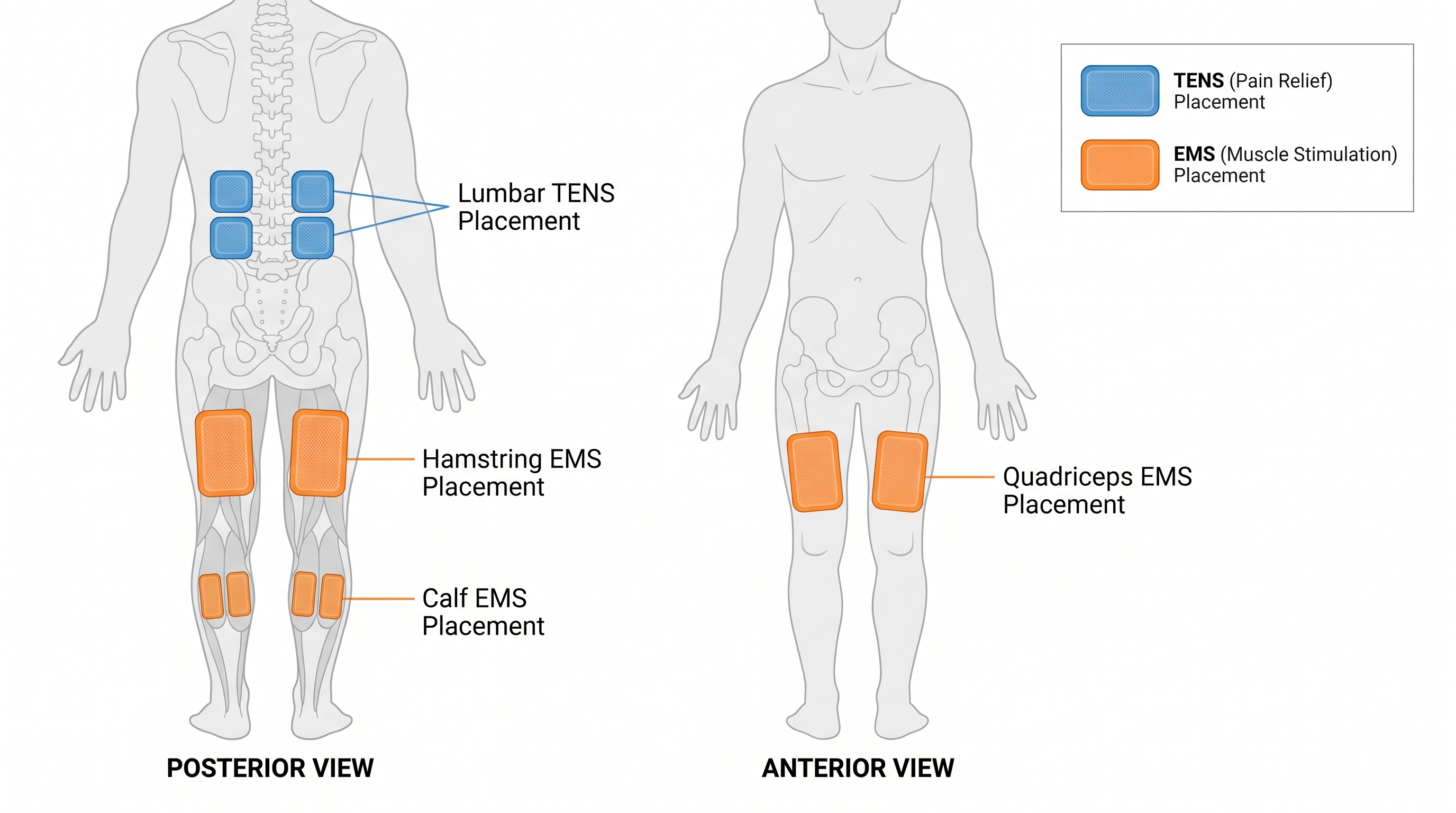
ALT: Correct TENS EMS electrode placement diagram for lower back and leg muscles in a weekly pain relief and muscle training schedule
Advanced Considerations: Adjusting Your Schedule for Special Situations
Managing Flare-Up Days
Chronic pain rarely follows a predictable schedule. When a flare-up hits mid-week, don't abandon your plan entirely — adapt it. Replace any planned EMS session with a longer TENS session at a comfortable intensity. Increasing EMS intensity during a pain flare can amplify discomfort and is counterproductive. TENS, however, is specifically designed for on-demand pain interruption and can safely be used more frequently on difficult days.
Combining Electrotherapy With Pelvic Floor Training
For women incorporating pelvic floor rehabilitation into their wellness routine, a TENS/EMS combo schedule pairs naturally with dedicated Kegel device sessions. Pelvic floor stimulators work on the same electrotherapy principles as EMS devices — targeted muscle contraction to strengthen and rehabilitate the pelvic floor muscles. The relationship between pelvic floor stimulation and overall wellbeing — including reduced pelvic pain, improved bladder control, and enhanced core stability — makes this an important addition to any comprehensive weekly plan. Schedule pelvic floor sessions on EMS days or as a standalone session on active recovery days for optimal integration.
Common Misconceptions About TENS and EMS at Home
Misconception 1: "More intensity means better results." In reality, the most effective TENS level is the highest comfortable intensity — not the maximum the device can deliver. Excessive intensity causes muscle guarding, skin irritation, and reduced therapeutic benefit.
Misconception 2: "You can use TENS and EMS simultaneously on the same area." Unless your device is specifically designed for simultaneous dual-mode operation, run TENS and EMS sequentially rather than concurrently on the same body region to avoid confusing nerve and motor signals.
Misconception 3: "Electrotherapy is only for elderly or severely injured people." TENS and EMS are used across the age and activity spectrum — from elite athletes optimizing recovery to desk workers managing postural pain. A weekly schedule is just as relevant for a 35-year-old runner as it is for a 60-year-old with arthritis.
Frequently Asked Questions FAQ
Q1: How do I know whether to use TENS or EMS on a given day for muscle recovery?
The best way to decide is to identify your primary need for that session. If pain or discomfort is your dominant symptom — making it hard to move or function — lead with TENS to modulate the pain signal first. If your primary goal is muscle activation, strength building, or preventing atrophy, EMS is your tool. For the best pain relief method for muscle recovery, many users find that a TENS session immediately before EMS optimizes both outcomes, as reduced pain sensitivity allows more effective muscle contraction during EMS.
Q2: Is it safe to use a TENS/EMS device every day as part of a weekly schedule?
For most healthy adults without contraindicated conditions, daily TENS use is generally considered safe when following manufacturer guidelines and keeping sessions within recommended durations. EMS is typically recommended every other day for the same muscle group to allow adequate muscle recovery between sessions — similar to resistance training principles. Always start with shorter sessions and lower intensities, and consult your healthcare provider if you have any underlying medical conditions before establishing a daily electrotherapy routine.
Q3: How long does it take to see results from a consistent weekly TENS/EMS schedule?
Most users report noticeable improvements in pain levels and muscle responsiveness within two to four weeks of consistent use. Muscle conditioning benefits from EMS typically become more apparent after four to six weeks of regular sessions, while TENS pain relief can be felt immediately during and after each session. Long-term benefits — including reduced chronic pain frequency, improved muscle tone, and better functional mobility — are most pronounced in users who maintain a structured weekly schedule rather than using devices only during acute pain episodes.
Summary
Creating a weekly pain relief and muscle training schedule using a TENS/EMS combo is not just a wellness strategy — it's a paradigm shift in how you approach your body's needs. The three core values of this approach are:
- Structured consistency beats occasional use: A deliberate weekly plan with TENS and EMS allocated to the right days and goals produces far superior outcomes to ad hoc device use during pain flares alone.
- The TENS-then-EMS principle is your cornerstone: Managing pain before activating muscles creates a physiological environment where healing and strengthening can actually occur — breaking the cycle of pain-inactivity-weakness.
- Personalization is essential: The framework provided here is a starting point, not a rigid prescription. Your body's response, your specific conditions, and your evolving goals should all shape how you refine your schedule week by week.
Your next step is simple: begin by assessing your primary pain and conditioning goals, invest in a quality TENS/EMS combo device, and commit to one full week of the schedule outlined above. Track how you feel each day, adjust as needed, and build on what works. Real, sustainable pain relief and muscle health are achievable — and they don't require a prescription.
Ready to take control of your pain relief and muscle health — without relying on drugs? iStim offers a full range of professional-grade TENS, EMS, and Kegel devices designed to deliver real results safely and effectively from the comfort of your home. Explore the complete lineup and find the right device for your needs at https://istim.com/.
References
- National Institute of Neurological Disorders and Stroke (NINDS). "Pain: Hope Through Research."
https://www.ninds.nih.gov/health-information/patient-caregiver-education/hope-through-research/pain-hope-through-research - American Physical Therapy Association (APTA). "Physical Agents and Electrophysiological Modalities — Clinical Practice Guidelines."
https://www.apta.org/ - National Institutes of Health — National Library of Medicine (PubMed). "Transcutaneous Electrical Nerve Stimulation for Pain Control: Clinical Evidence and Mechanisms."
https://pubmed.ncbi.nlm.nih.gov/ - Mayo Clinic. "TENS (Transcutaneous Electrical Nerve Stimulation) — About This Treatment."
https://www.mayoclinic.org/tests-procedures/tens/about/pac-20384884 - U.S. Food and Drug Administration (FDA). "TENS Devices — Consumer Information."
https://www.fda.gov/medical-devices/consumer-products/tens-transcutaneous-electrical-nerve-stimulators
Note: Standards and clinical guidelines may be updated. Please check the latest official documents or consult a qualified healthcare professional for the most current recommendations.
About iStim
iStim is a Los Angeles-based electrotherapy brand specializing in professional-grade TENS, EMS, and Kegel devices for home use, trusted by 20,000+ customers and manufactured to ISO-certified standards for safe, drug-free pain relief and muscle stimulation. Learn more at istim.com.
Disclaimer: This article is provided for informational and educational purposes only and does not constitute medical advice. The content is produced in partnership with iStim. Always consult a qualified healthcare professional before starting any new therapy or treatment. © iStim. All rights reserved.
Leave a comment